
[Editor's note update, October 2026: EPA still hasn't finalized its proposal to end the Greenhouse Gas Reporting Program. It pushed the 2025 Subpart RR reporting deadline to October 30, 2026, and in August Treasury and the IRS expanded the 45Q safe harbor (Notice 2026-50) to cover EOR projects and reporting years after 2025.]
CO2 permitting meets EOR reality
This is oversimplifying, but when it comes to CO2 in the US, there are two types of wells that matter: Class II, used for CO2 injection into depleted oil formations for enhanced oil recovery (EOR), and Class VI, used for CO2 injection with the express purpose of long-term CO2 storage.
Class VI wells have traditionally been regulated by the US EPA. But there's a growing trend of individual states taking primacy over permitting, enforcement, and oversight of these wells, in an effort to reduce long permitting timelines and boost CO2 storage activities. Five states have Class VI primacy (North Dakota, Wyoming, Louisiana, West Virginia, and Arizona), and on November 12, Texas became the sixth when the EPA granted the Texas Railroad Commission full authority over Class VI wells.
This is the big one. Given the scale of Texas's subsurface activities and existing infrastructure (anyone else watching Landman?), speeding up permitting for Class VI wells is something that could actually kickstart movement for geologic storage. Or could it?
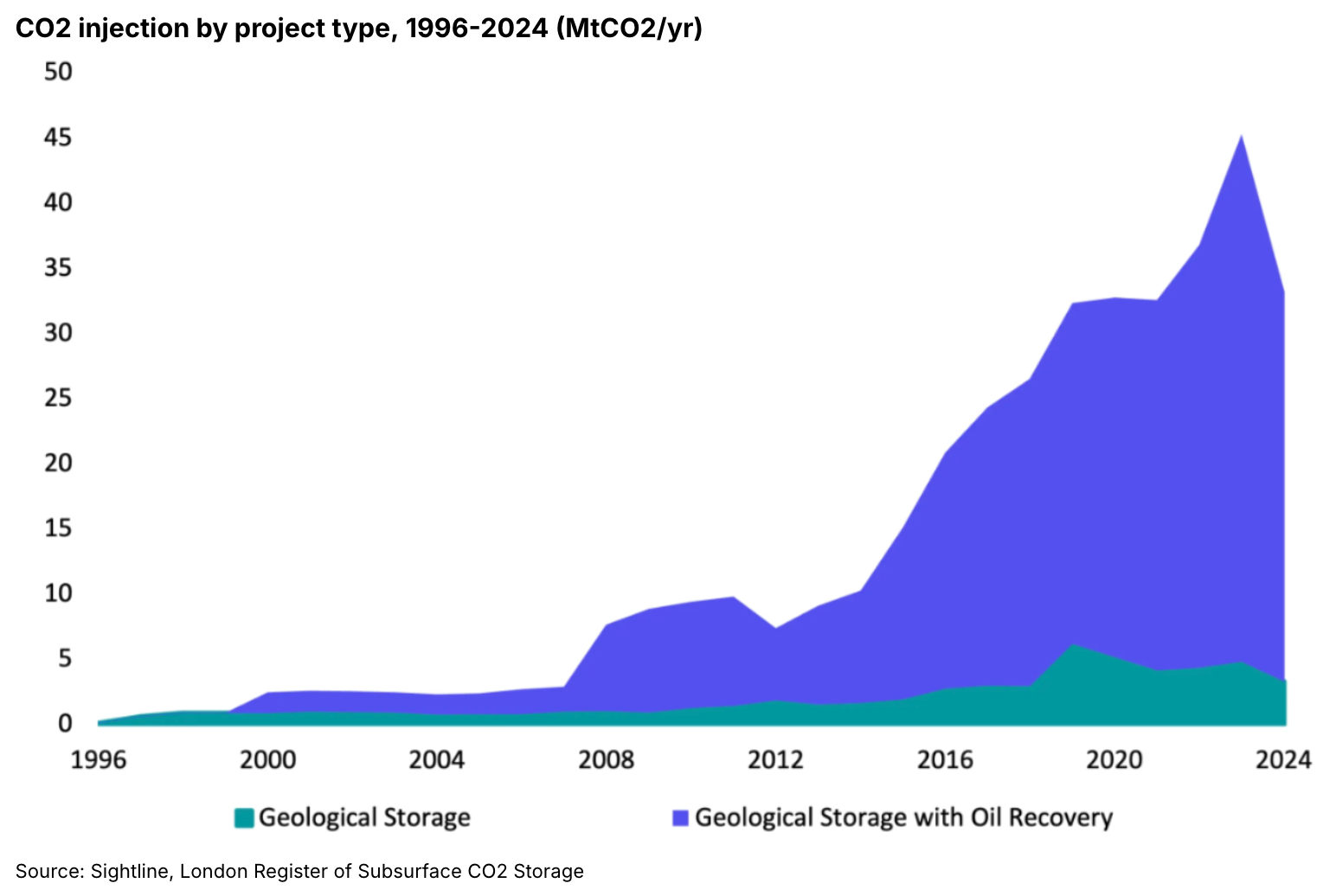
We analyzed Texas's Class VI primacy and reviewed the latest data on global CO2 injection since 1996. Together they give a clearer picture of where CO2 is actually going in 2025. Here are a few things that stuck out to me.
1. Speeding Class VI permitting is great, but Class II is king. Texas primacy will shorten Class VI review timelines, but Paola shows it's still all about EOR, even outside the US. Globally, 85% of injected CO2 is actually used for EOR, and in the US, it's not even close. Looking at the latest available EPA data for wells of all types and statuses (proposed, under construction, active, etc.), in 2023 there were 49,821 Class II wells. How many Class VI? Just 15. So go up two orders of magnitude, and you're still not there.
This doesn't mean there's not an industry to be had or built for pure storage, and faster permitting would help with that for sure. But today, all the CO2 muscle in Texas is trained for EOR.
2. 45Q is the driver and the risk. Class VI approvals will move faster with state primacy, but for me the real kicker is downstream in 45Q. EPA has historically been responsible for CO2 storage verification under the Greenhouse Gas Reporting Program (GHGRP), and this verification forms the basis for 45Q claims. But in September, EPA put forth a proposal to eliminate GHGRP, meaning it won't collect the data anymore, and Treasury will have to figure out a new system to get the data. Or said differently, tough luck.
The short end of the stick goes to the operators who will still owe the data to the IRS. They'll still be able to claim credits under 45Q, but this likely sets up a system of self-reporting, where the risk of audit and recapture looms large. So as permitting gets faster and more wells get approved, it actually widens the data gap and could ultimately make it harder for companies to claim and keep credits for the CO2 they inject.
3. CO2 could shift from EOR to storage. Paola points out that a real shift could happen once EOR fields start running out of oil, or once the economics no longer pencil. But operators will keep using CO2 for EOR as long as it makes more money than storing it. And right now, it definitely does. 45Q pays the same credit for EOR and storage, but EOR also produces oil, so the total return is higher. For storage to compete on its own, projects would need $80-130/tCO2 to match or beat the last marginal barrel.
So while Texas primacy will speed up permitting for Class VI wells, the infrastructure in place and the incentive alignment make it seem like this flip to geologic storage could take geologic time. For more on where the CCS pipeline is headed, see our Q1 2026 Carbon Outlook.
If you're interested in learning more about our carbon coverage, request a 20-minute call with our team.