The UK is aiming to be the first major economy to run a net-zero power system. Last week, Ofgem laid out what that takes, publishing its next five-year price-control plan, RIIO-3, which sets the funding and performance rules for Britain’s gas and high-voltage electricity networks from 2026 to 2031.
RIIO-3 sets new funding and performance rules for Britain’s gas and high-voltage electricity networks from 2026 to 2031. It’s used for three things: 1) give monopoly networks enough certainty on returns to raise tens of billions of capital; 2) protect consumers from overpaying through efficiency challenges and output-based incentives; and 3) keep flexibility as policy, technology, and demand change.
This new decision previews the politics of grid buildout, affordability, and investor returns that every electrifying economy now faces.
What happened
Ofgem greenlit an initial £28bn ($37.3bn) of spend, which includes £17.8bn ($23.7bn) for gas and £10.3bn ($13.7bn) for electricity transmission. The initial £28bn is only the opening tranche; the total could reach about £90bn with future project phases and reopens.
On the investor side, RIIO-3 resets investor terms, setting a 6.1% real cost of equity at 60% gearing for transmission. On the electricity side, transmission owners will receive funding to progress roughly 80 projects, from new transmission lines to HVDC cables lines to substations to early-stage investments for offshore wind integration, storage projects, and hydrogen-ready infrastructure.
The regulator estimates the package will add about £108 to household bills by 2031, but argues that cutting imported gas dependence and grid-constraint costs should offset most of the increase, and the net impact should fall to around £30/year as costs decline and system benefits accumulate.
Why it matters
Like most major economies, the UK’s grid is in a squeeze. The government still targets a largely decarbonized power system by 2035 and net-zero by 2050, but power demand is rising again after a decade of stagnation. EVs, heat pumps, data centers, and electrolyzers are all pulling load. Coal has nearly disappeared, but the gas system still carries the impact of the 2022 Russia shock, which drove household bills to record levels and made cutting exposure to volatile LNG imports a political priority. It also strengthened the case for shifting faster away from imported gas, but this requires a grid that can absorb more renewables and move them around, i.e. its offshore wind buildout depends on shifting huge volumes of Scottish generation to England’s demand centers.
The UK’s aggressive decarbonization plans need to come with an aggressive grid plan. Grid operators must rapidly find better ways to incorporate the country’s DERs and leverage commercial and industrial demand response to provide stable, clean power. This would normally call for massive investment in grid infrastructure, but the UK already faces a budget shortfall and rising taxes. It needs private capital and novel technologies to allow it to do more with less.
Still, private capital only moves if the return is high enough to justify tying up money in long-lived, policy-exposed assets. If returns are too low, the £90bn transmission buildout slows. If they’re too high, households pay more.
Ofgem’s last 5-year plan, RIIO-2, aggressively pushed the cost of equity down for network companies and, behind them, the investors financing these regulated asset bases. For RIIO-3, it’s moved closer to where debt and equity markets actually price risk, setting a 6.1% real cost of equity at 60% gearing for transmission. The level is still below what some investors argue is needed for energy assets, but a reset that acknowledges a higher-rate world (and greater perceived risk).
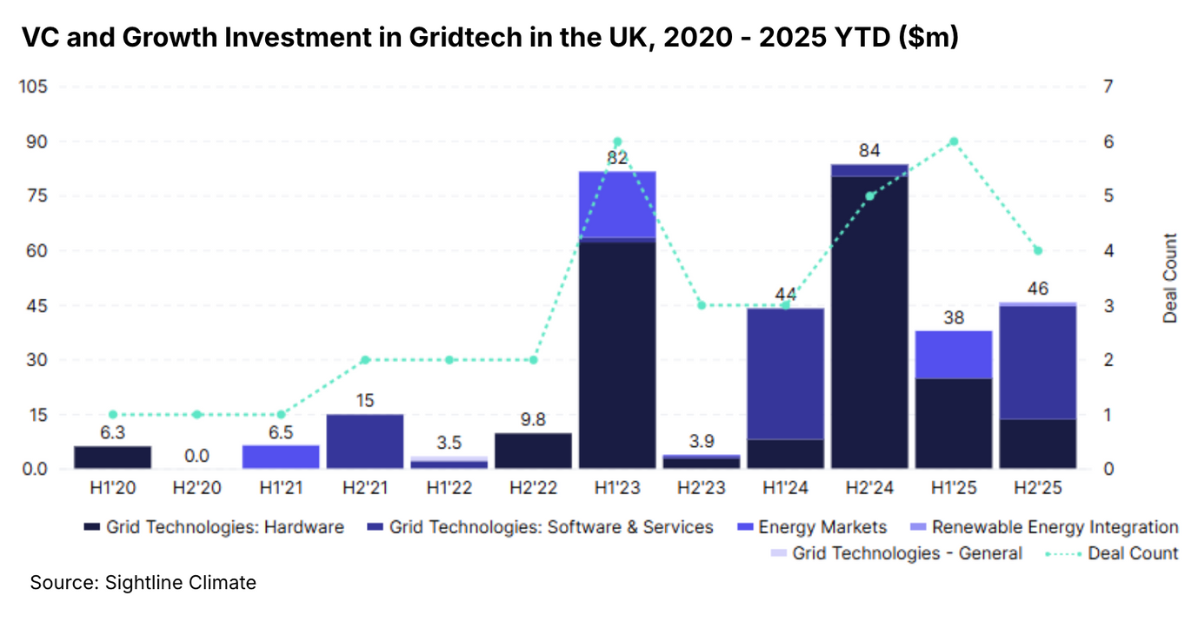
Gridtech VC investment has had a pretty good few years in the UK (see below), and startups are anxious for pilot programs to prove they can deliver cost savings and capacity increases. RIIO-3 could create a testing ground for which early-stage technologies can compete at today’s cost of capital, and which ones remain too expensive for networks to justify.
With the EU, US, and Australia facing similar dilemmas, many will be watching for early benchmarks on how to structure returns, manage affordability, and still secure the transmission buildout required for electrification.
Key takeaways
1. Affordability and the need to front-load capex collide. RIIO-3 forces higher near-term bills to secure long-run resilience, but households already face elevated costs and thin political headroom. Regulators may need new cost-sharing models and tougher efficiency targets to keep the buildout moving. The UK is going first, but the EU and US are wrestling with similar trade-offs (US utilities are already planning $1.1T in the next 5 years on grid upgrades).
2. The cost of capital will shape who builds what, and how fast. A 6.12% real equity return looks rich compared with RIIO-2, but infrastructure funds, pension schemes, and sovereigns compare it with unregulated assets and other geographies. Low returns slow buildout, but too-high returns mean costs fall on consumers facing cost-of-living pressure. RIIO-3 tries to make things investable, but there’s no right answer.
3. Networks are now central climate actors. Renewables domination brings real focus on networks. Their choices drive curtailment rates, connection queues, and electrification timelines. A higher allowed return also shapes which technologies scale: operators can back early-stage stability tools like grid-forming inverters, long-duration storage, or advanced HVDC only if the regulatory return gives them room to take technology risk.