

There’s been a lot of buzz around Small Modular Reactors (SMRs) lately, from Google’s deal with Elementl Power to Amazon’s deal with X-energy. But it’s not just Big Tech looking for clean firm power for data centers. The UK government has been in the game too, having launched a competitive tender in 2023 before demand-growth meant it was even cool to evaluate SMR designs for deployment.
The stated goal behind the plan is to support up to 3,000 jobs, power 3 million homes (with the first deployment) and provide reliable, low-carbon power as part of a next-gen nuclear fleet that will also include Sizewell C and Hinkley Point C. And it’s not just stated goals—the government has committed over £2.5bn ($3.4bn) to the SMR program, aiming to bring the first unit online by the mid-2030s.
This week, it named a winner: Rolls-Royce. And it changes everything.
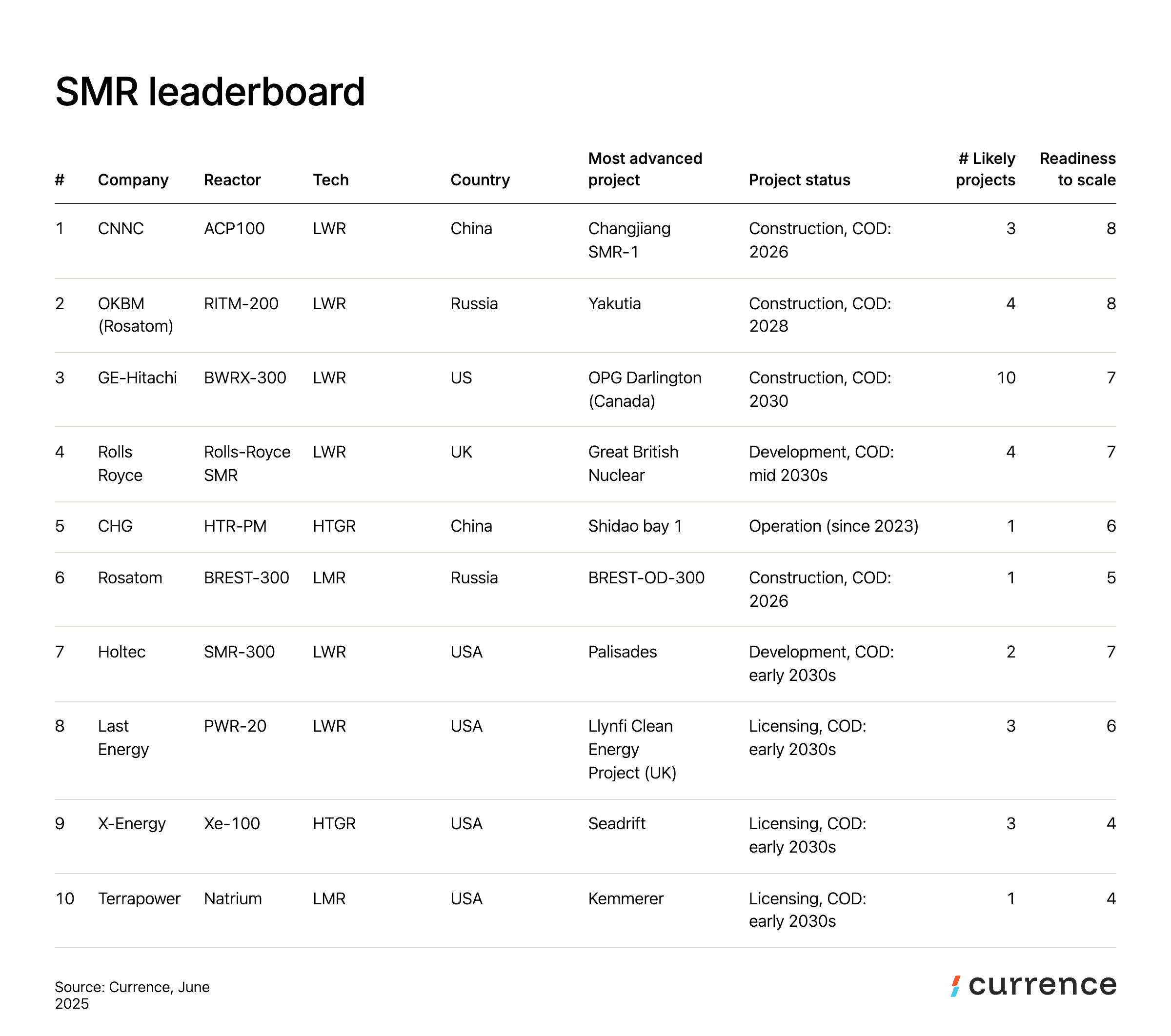
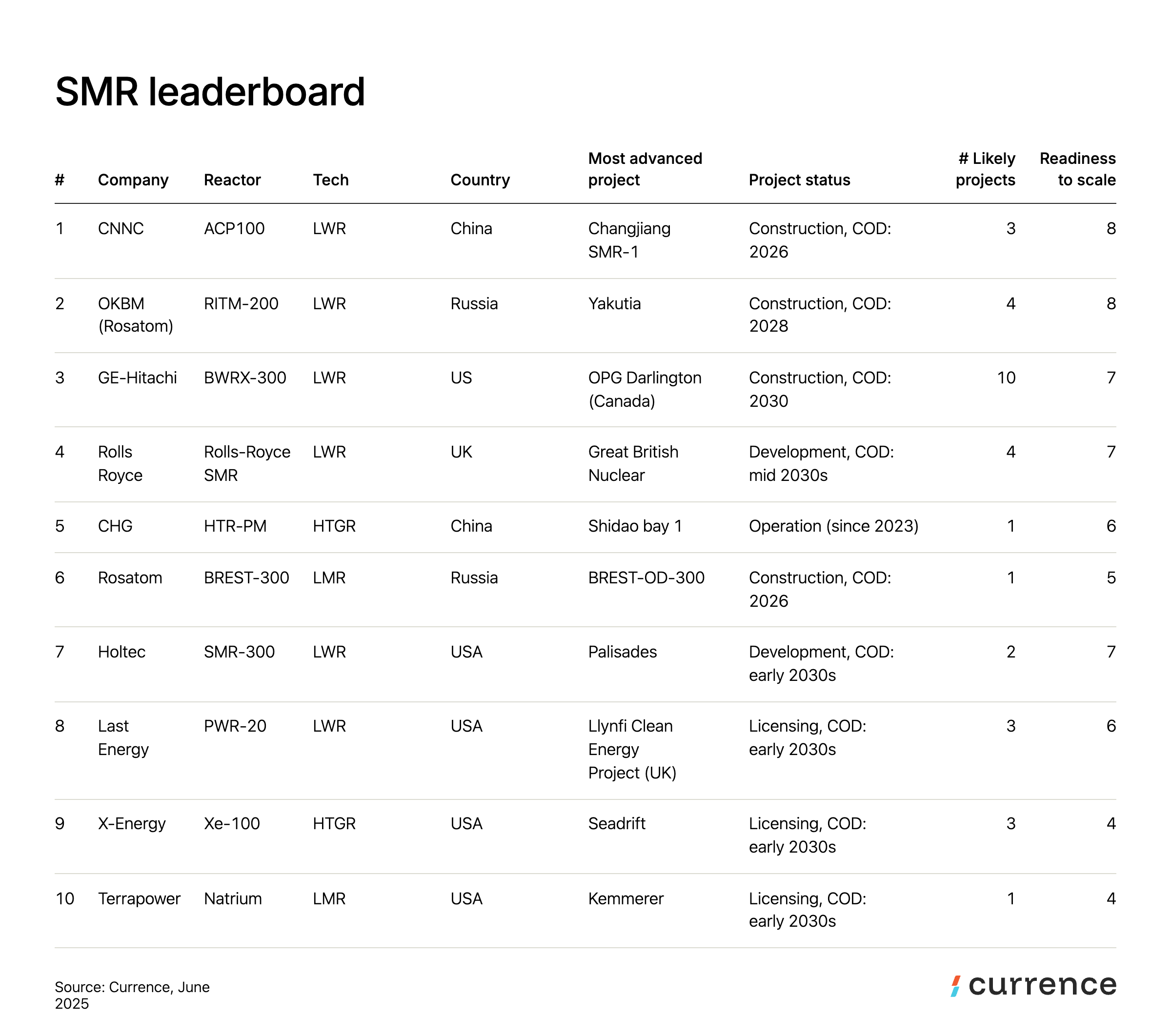
We took a look across the board, and put together a leaderboard ranking the different companies that we think are best positioned to thrive and scale. For the full methodology and a longer list, read this Currence analysis from our clean firm power analyst, Guy Cohen. For any questions, give us a shout—happy to connect you with Guy.
But in looking at the leaderboard in light of the Rolls-Royce announcement, we can see:
- An SMR tech type leader emerges. Rolls-Royce’s SMR design uses a pressurized water reactor, a scaled-down, factory-built version of traditional nuclear tech. Each unit is designed to generate 470MW of electricity and the initial deployment will include three reactors. The top four of the leaderboard below are light water reactors; smaller versions of the reactors that make up around 90% of nuclear power today. Regulators and engineering firms know them, and their supply chains are already scaled up.
- Major step toward actual SMR development. SMRs have been touted for years as a more flexible, scalable, affordable nuclear option in a sector with a track record of high costs, long timelines, and massive cost overruns. Still, no commercial SMRs are online anywhere in the world yet. A handful of demonstration projects are underway globally, and the UK’s selection of Rolls-Royce is a significant vote of confidence in a crowded field of potential SMR vendors.
- Rolls-Royce builds momentum. This announcement is a big bet on a relatively established player, both in terms of confidence and funding. This is the second SMR competition Rolls-Royce has won, following its success in 2024 in the Czech Republic. The company now has an order book most other SMR developers lack. And Rolls-Royce will have access to not only UK nuclear plant Sizewell C’s funds, but also £2.5bn from this tender. The FID is expected in 2029, with three SMRs expected to be deployed by the mid 2030s.
Our leadership board scores and rankings are subjective and should be treated as such. However, the top two; CNNC’s ACP100 and Rosatom’s RITM-200, are the clear leaders today. It's debatable which of the two of them is in the lead, but in our view they are significantly ahead of others. You can see the top ten below, but our analysis on the platform has the top 20.
After years of build-up, the SMR race is finally down to names, numbers, and near-term milestones — but it’s still anyone’s game.