The sun doesn’t always shine, and the wind doesn’t always blow. Even when conditions are perfect, renewable energy doesn’t always line up with peak demand. This mismatch creates one of the biggest challenges in the clean energy transition: how to store clean electrons and release them when we actually need them.
As renewable energy expands, grids that reach about 60% penetration from wind and solar hit a tipping point. At this stage, the gap between when energy is produced (like midday solar or windy nights) and when it’s needed (evenings, seasonal peaks) becomes stark. To balance supply and demand, we have two main options:
- Expand transmission infrastructure to move electrons across longer distances.
- Deploy long-duration energy storage (LDES) to hold energy for hours, days, or even weeks.
With power demand rising and transmission projects slowed by permitting and costs, storage is increasingly viewed as the more scalable solution. Not just any storage works. To balance renewable intermittency requires systems that last 12 hours or more. Technologies in the 8-hour to multi-day range fall under the umbrella of long-duration energy storage (LDES).
What is Long-Duration Energy Storage (LDES)?
LDES refers to technologies that can store electricity for 8 hours or longer, with some capable of delivering power for days or even entire seasons. Unlike short-duration lithium-ion batteries (commonly used for 1–4 hour balancing), LDES provides the deep reserves needed for a cleaner, more resilient grid.
The role of LDES in a cleaner, more reliable grid
LDES does more than just balance supply and demand. It strengthens the energy system by:
- Improving reliability: Smoothing out renewable variability.
- Enhancing resilience: Keeping critical infrastructure running during outages.
- Boosting sustainability: Replacing fossil-fuel peaker plants that operate only a few hundred hours a year.
How energy markets value storage

Electricity markets exist to do one main thing: perfectly match generation with demand, 24/7, safely and reliably. Storage fits into this system by providing flexibility across several layers:
- Capacity markets: Pay providers years in advance to guarantee future reliability. LDES assets can secure long-term contracts here.
- Energy markets: Operate in real time, balancing supply and demand daily or hourly.
- Spot, balancing, and ancillary services:
- Spot markets: Next-day or intraday trading.
- Balancing markets: Adjust supply minute by minute.
- Ancillary services: Stabilize grid voltage and frequency.
Where LDES fits: These assets buy power when it’s cheap (during renewable surpluses) and sell it back when prices spike. They also earn through capacity and ancillary markets—making them both reliable and profitable.
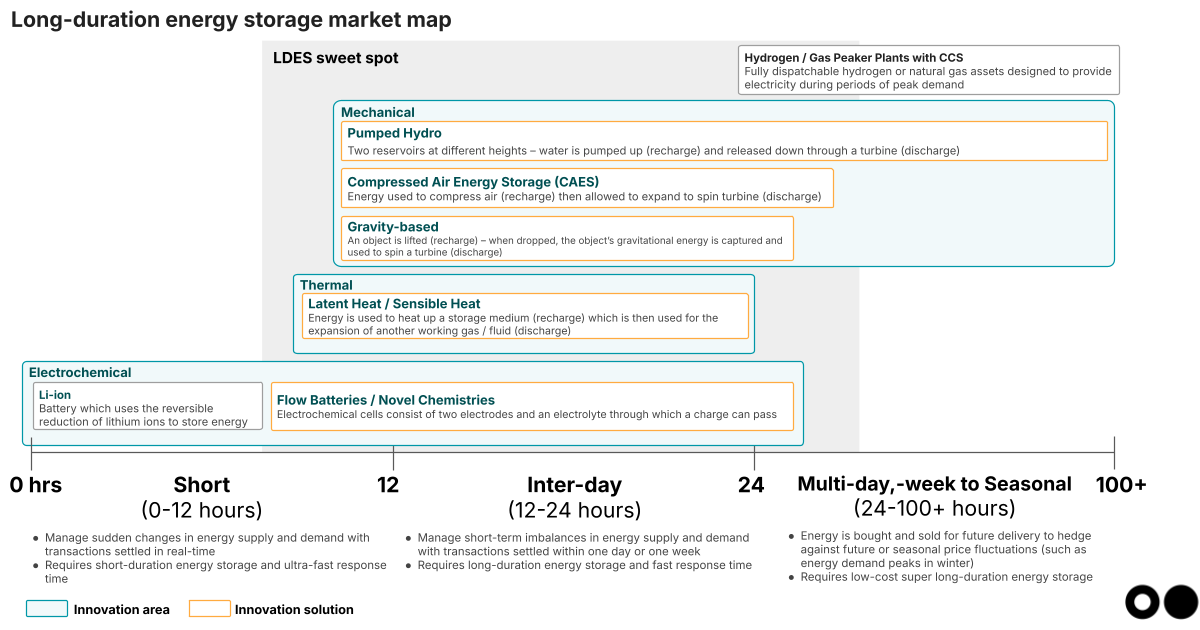
LDES Across Different Timescales
Different storage durations solve different problems:
- Intraday (<24 hours): Best for peak shifting. Dominated by lithium-ion.
- Multi-day/week (24–100 hours): Covers storms, outages, and extended lulls in renewables.
- Seasonal (100+ hours): Bridges variability across entire seasons and can replace gas peakers.
Types of LDES Pathways
LDES falls into three broad categories:
- Mechanical
- Compressed Air (Hydrostor, Apex): 6–100 hrs
- Liquid Air (Highview Power): 4–24 hrs
- Gravity (Energy Vault, Gravitricity): 8–24 hrs
- Pumped Hydro (Quidnet, MineStorage): 10–1,000+ hrs
- Electrochemical
- Metal-Air (Form Energy, Zinc8): 8–100 hrs
- Novel Chemistries (Ambri, Eos): 4–16 hrs
- Flow Batteries (ESS, Invinity): 8–24 hrs
- Thermal
- Latent Heat (Azelio, StorWorks): 8–24 hrs
- Sensible Heat (Malta, EnergyNest): 8–24 hrs
LDES, then and now
- Pumped Hydro: Proven for 100+ years, with over 150 GW installed worldwide.
- Compressed Air: First commercialized in the 1970s with mixed success.
- Flow Batteries: Saw hype in the 2000s–2010s but struggled with costs.
- Advanced Batteries: Many startups failed (Aquion, A123), but new chemistries are gaining ground.
Meanwhile, lithium-ion surged ahead thanks to EV-driven supply chains, dominating the short-duration market. Now, as grids need longer-duration solutions, LDES is re-emerging as the frontrunner.
The Current Boom in LDES Investment
Despite past failures, LDES is experiencing a surge of investor enthusiasm:
- Funding soared from $100M to $2.3B in just five years.
- 2021 alone saw a 300% increase, led by mega-rounds for Form Energy and Energy Vault.
- Nearly half of active LDES companies were founded after 2017.
Investor takeaway: The sector is still early, but the combination of climate resilience, grid reliability, and policy incentives is driving rapid scaling.
Key Performance Metrics for LDES
- Duration: 8 hours to multiple weeks
- Cost: Higher upfront than Li-ion, but lower marginal cost per MWh added
- Lifetime: 20–50 years (vs. 6–10 years for Li-ion)
- Scalability: Flexible scaling, often less reliant on critical minerals
- Safety: Lower fire risk than lithium-ion
- Supply Chain Security: Less exposed to cobalt, nickel, or lithium volatility
- LCOS (Levelized Cost of Storage): Still variable, but improving with scale
Challenges & Risks to Watch
- Competition from nuclear, geothermal, and fusion for baseload power.
- Raw material supply risks (vanadium, zinc, cobalt).
- Faster-than-expected transmission upgrades reducing demand for LDES.
- Sodium-ion batteries emerging as a cheaper alternative.
Future Pathways for LDES
To succeed at scale, LDES providers must:
- Develop modular, productized solutions instead of custom projects.
- Strengthen go-to-market strategies with tools like grid modeling software.
- Advocate for policy incentives targeting >4-hour storage.
- Support microgrids in remote and emerging markets.
FAQs on LDES
- What is LDES?
Energy storage that lasts 8 hours to weeks, bridging renewable gaps. - How does it differ from Li-ion?
Li-ion is cost-effective for short durations; LDES offers longer lifetimes and resilience. - Why is LDES important?
It ensures reliable power during renewable lulls, enabling higher clean penetration. - Which technologies are leading?
Mechanical (hydro, compressed air), electrochemical (metal-air, flow), and thermal storage. - What are the biggest challenges?
High upfront costs, supply chain risks, and competition from other clean energy sources.