Lithium-ion: Still the current favorite
To charge up emerging long-duration energy storage (LDES), governments have been rolling out targeted policies — and this past month, two of the most ambitious programs to date wrapped their first rounds. But instead of backing next-gen tech, both the UK and Italy plugged right back into the dominant short-duration incumbent: lithium-ion.
Turns out, the best way to scale long-duration storage in 2025 … might be to use the tech we already have.
What happened
As grids transition to renewables and power demand climbs, long-duration energy storage — systems that can discharge for 8+ hours, well beyond the typical 1–4 hour window — is becoming essential to smooth out intermittent generation and avoid curtailment. In Europe, the push is especially urgent: countries are working to decarbonize faster, replace aging thermal fleets, and cut dependence on Russian gas without sacrificing grid reliability.
Italy and the UK are test cases for this. Earlier this month, Italian transmission system operator Terna announced the results of its first-ever energy stroage auction for 10GWh of capacity, open to battery systems with durations of 2, 4, 6, and 8 hours. The auction was 4x oversubscribed, but all winning bids came from li-ion projects, coming in cost-competitively at an average €12,959/MWh-year ($15,087) — well below the €37,000 ($43,079) cap. Most of the capacity went to larger players like Enel and Eni, with 15-year contracts starting in 2028.
In the UK, Ofgem advanced 77 LDES projects (28.7GW) to the next phase of its new LDES cap-and-floor program, after disqualifying 94 proposals for failing to prove tech readiness or deliverability. The scheme targets 2.7–7.7GW of inter-day storage (projects that discharge for 8+ hours) by 2035, and 70% of this newly eligible capacity is lithium-ion, excluding pumped hydro. A few emerging technologies made the cut — including 3.8GW of vanadium flow and 1.3GW of zinc-bromine — but they remain the exception.
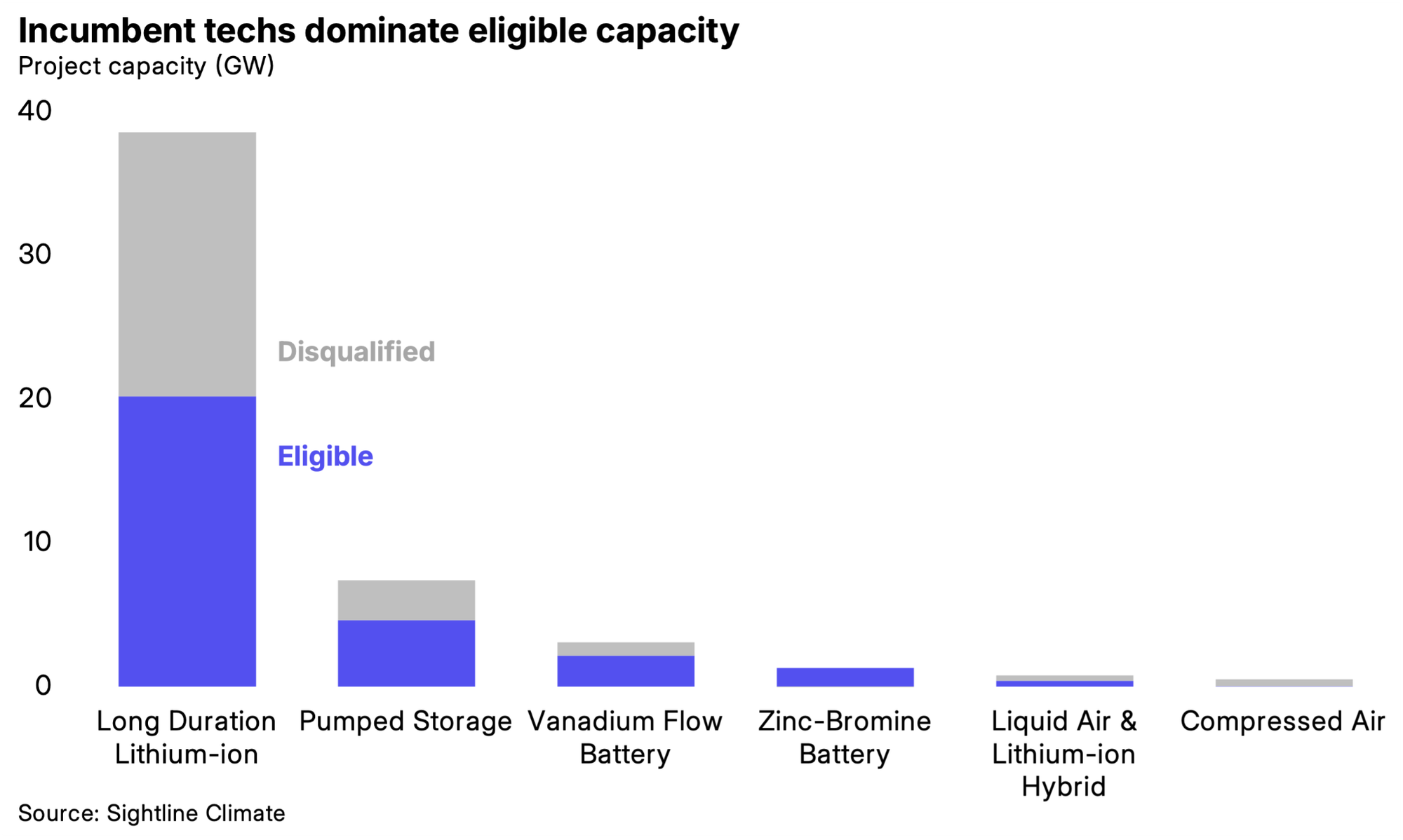
Despite being intended to unlock flexible, inter-day storage, both tenders awarded the bulk of capacity to lithium-ion — the only tech that cleared today’s cost and readiness bar.
Why it matters
These tenders were supposed to be breakout moments for emerging LDES techs. The assumption was that newer technologies like flow, compressed air, or iron-air would step in while lithium-ion would cap out around four hours. (Lithium-ion's high power density makes it the storage technology of choice for ≤4 hours, with decades of R&D and large-scale use in electric vehicles delivering lower costs than anything else.) But instead, Li-ion extended its lead, even at 8+-hour durations it hasn’t historically dominated.
That’s partly because most emerging techs still come with higher capex and opex than incumbent lithium-ion. [Currence (formerly Sightline Climate) clients can access research briefings here to learn more about the benchmarks behind this analysis.] And Li-ion at any duration continues to benefit from economies of scale, from mature supply chains to established manufacturing pathways. Big players are now actively designing for longer durations: in just the past year, CATL and Quinbrook launched a DC block optimized for 8-hour storage, Hithium began mass-producing 4-hour cells, and LEAD unveiled dry electrode equipment for thick-electrode, long-duration formats.
Ironically, the policies meant to unlock innovation have ended up reinforcing Li-ion’s dominance. Italy offered 15-year fixed contracts, exactly the kind of revenue certainty newer techs need. But only lithium-ion could hit the bankability and pricing targets. In the UK, Ofgem’s eligibility screen knocked out most alternatives before they could even bid.
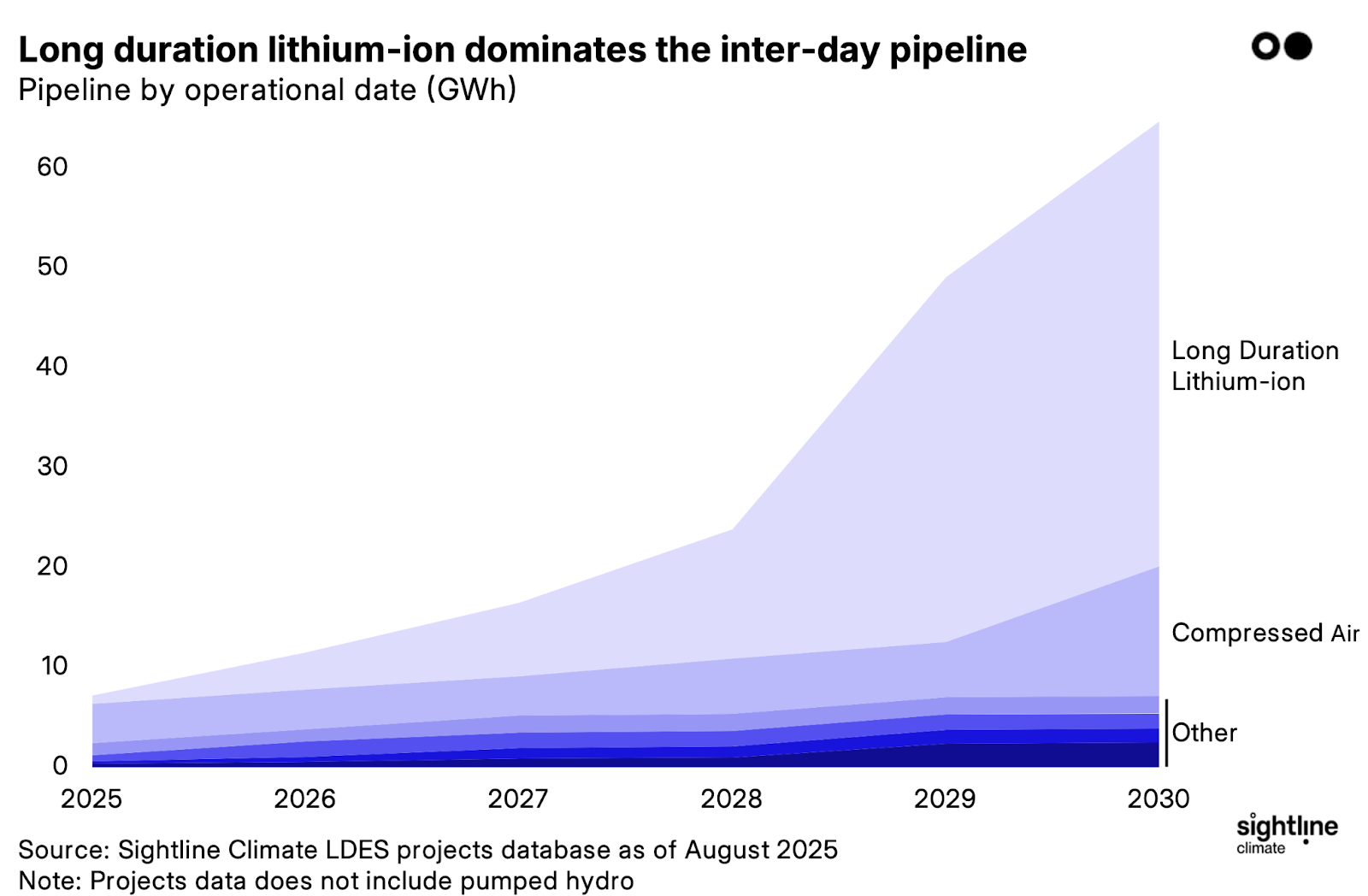
As we wrote last month in Energy-Storage.News, lithium-ion already accounts for 70% of the 64.7GWh of inter-day LDES projects that are targeting operations by 2030, more than triple the second most deployed tech, compressed air (20%).
Interested in learning more about Currence’s LDES projects and benchmarking data? Talk to our experts here.
Its footprint is expanding, too — beyond balancing renewables to powering data centers and AI infrastructure. Aligned Data Centers announced it is adding a 31MW/62MWh lithium-ion battery from Calibrant Energy to a data center, aiming to fast-track interconnection and skip years of grid delays. Redwood Materials is reusing EV cells to power modular data centers (and the company announced a fresh $350m raise this week). It’s a fast-growing, well-funded use case.
Still, the tech’s scale advantage means supply chain dependency, particularly on China, which dominates cell manufacturing and key materials processing. Even as Li-ion wins on cost and readiness, the geopolitical and resource risks remain.
Key takeaways
- Markets aren’t waiting for a breakthrough. Italy and the UK both built tech-neutral programs to scale long-duration storage, and got exactly what tech-neutrality rewards: low cost, proven delivery. Lithium-ion swept because it’s already bankable, manufacturable, and deployable at scale, from 2- to 8+-hour durations. Developers, lenders, and OEMs are moving forward with what works now, and that’s not necessarily a bad thing.
- Policy alone won’t diversify the tech stack. If governments want earlier-stage innovation beyond just lithium-ion, they’ll need to explicitly design for it, with tailored risk-sharing, lower readiness bars, or carve-outs for newer technologies. But there could be domestic security cases for it: avoiding Chinese supply chains. The UK’s selection criteria does include a “strategic” component designed to ensure tech and geographical diversity among the winning projects, which could give more expensive emerging techs a chance to be selected.
- Batteries as both grid infrastructure and AI infrastructure? The Aligned and Redwood announcements show a new kind of BESS customer emerging: hyperscalers and compute builders with money to spend and no time to wait. If these use cases scale, the storage market could expand to include capacity-as-a-service for high-growth industries.