

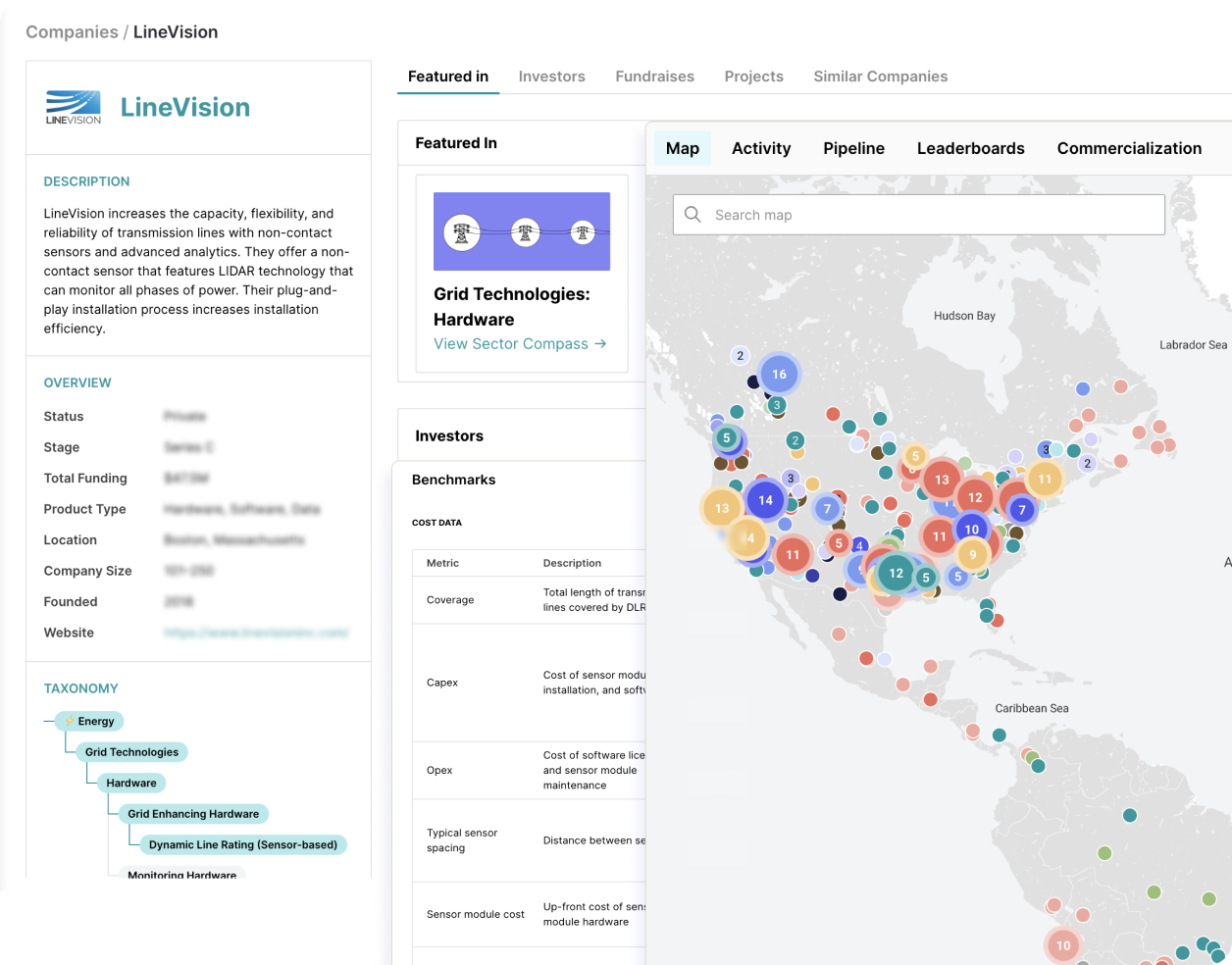
Compass maps 60,000+ companies, 40,000+ transactions, and 800 technologies across the physical economy, so innovation and strategy teams can tell what's real before everyone else does.
For the past three years, our flagship product has been a market intelligence platform that tracks which companies and technologies across energy, industrials, and robotics are commercially real and gaining traction. Today, we're bringing that research and data together as a single product named Compass.
Four supercycles are compounding at once: energy, AI, manufacturing, and reshoring. Together they are driving the largest infrastructure investment cycle in a generation, and capital is pouring in from corporate balance sheets, growth equity, private equity, and sovereign funds, all of it chasing the same thing: the companies and technologies that will build the next version of the physical economy.
That economy is genuinely hard to read. Physical-asset industries like power, storage, manufacturing, and fuels don't fit squarely into the databases built for software and consumer markets, where a company is more or less its product and traction shows up as a revenue line.
The hard part is knowing which companies are real: which have crossed from pilot to commercial scale, and which are still stuck in pilot purgatory dressed up as momentum. Guessing wrong is expensive, because a misjudged partner, acquisition, or investment compounds across procurement and diligence cycles that can run for the better part of a year.
Every existing tool leaves a gap
Legacy market intelligence is strong on macro outlooks and project data but thin on private companies and emerging technology, and it ships in quarterly PDFs that are stale before they're read.
Generic company databases carry broad deal data, but their categories are too coarse to be useful, and the signal worth having gets buried in buckets as vague as "energy tech."
And the general-purpose AI tools many teams now reach for will confidently summarize a sector in seconds, but they hallucinate companies that don't exist, miss the ones that matter, and have no way to tell a financed project from a press release. The practical result is a lot of time spent stitching sources together, and a decision made while still half-guessing.
What the market actually needs is intelligence that answers a sharper question: not just which companies exist, but which are differentiated, deployed, and commercially proven. That calls for depth of expertise backed by the deal and traction data, kept current and available in the tools where the work already happens rather than locked in a report from last quarter. Compass is built to do exactly that.
Compass works in three moves
Map. Compass landscapes any sector across a taxonomy of 1,300+ categories built by domain experts, granular enough to drill from energy storage down through long-duration, electrochemical, and metal-air batteries, and to see every player positioned across the value chain. Where a generalist database lumps all of those companies into one bucket, Compass lays out the full field, so no credible option goes unseen.
Monitor. Markets moving this fast tend to turn before the turn is obvious, and no team can watch the whole field. Compass ingests more than 10,000 signals a week, from funding rounds and deployments to contracts, permits, and partnerships, and tracks each technology from first pilot through demonstration to commercial rollout. When a vendor crosses from demonstration into commercial operation, or capital starts concentrating in one approach over another, the shift surfaces in the data while there's still time to act on it.
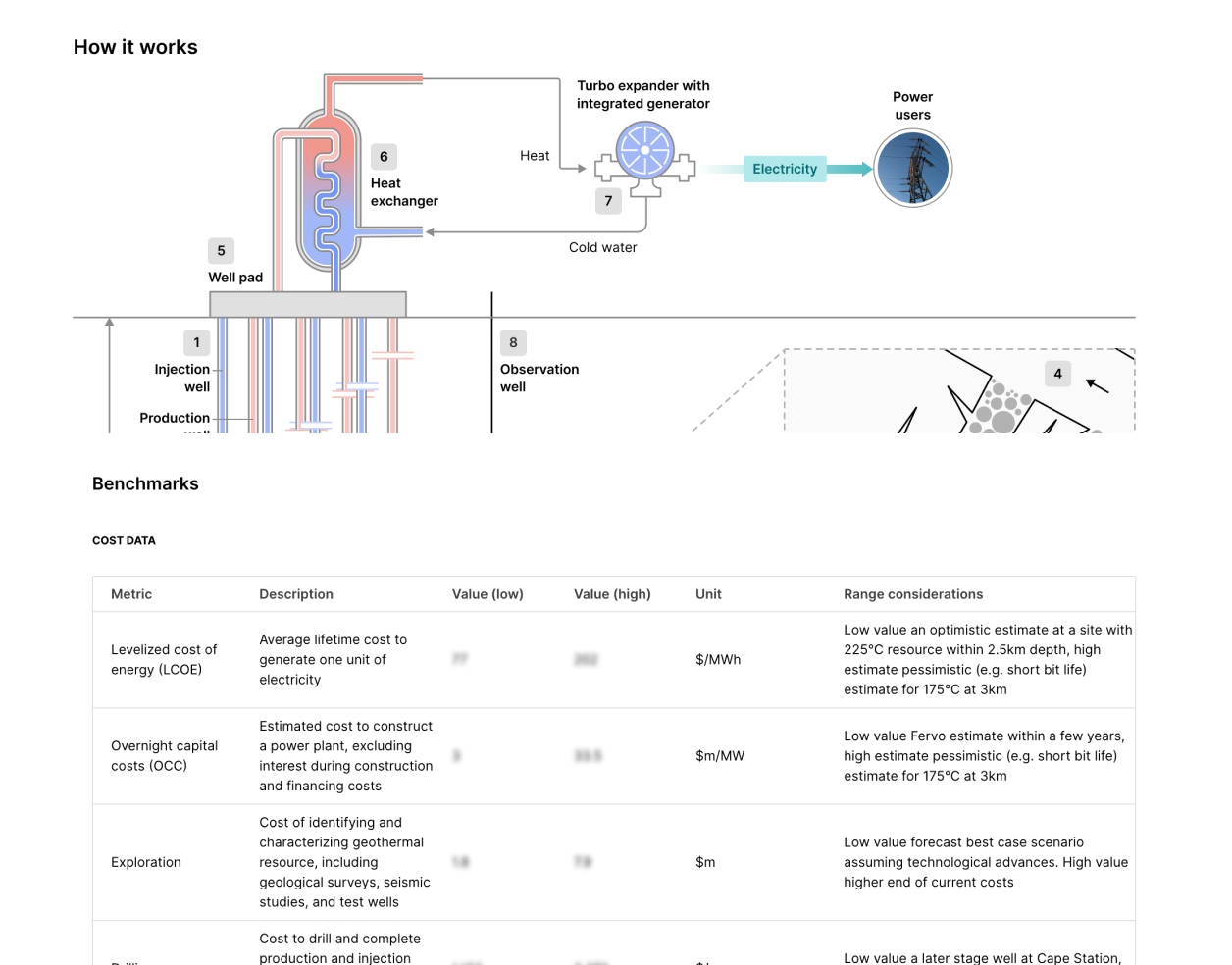
Shortlist. We rank leading companies supplying a given technology across technology performance, financial profile, deployment track record, and economics. Built on verifiable and proprietary data, each ranking gives an unbiased read on who is pulling ahead, who is stalling, and why, and traces back to the data underneath it.

Take a utility weighing long-duration storage options, with iron-air on the list. The pitch is appealing: cheaper per kilowatt-hour than lithium-ion, with the multi-day duration a renewables-heavy grid increasingly needs. Compass scores every technology on a Readiness Score that runs across seven dimensions: technology, finance, demand, deployment, players, economics, and policy.
Iron-air comes in at 3.1 out of 5 with genuinely best-in-class pricing, the rare chemistry whose capex undercuts lithium-ion, and it benefits from unusually strong policy support, with multi-day storage mandates in states like California and Massachusetts and few credible competitors at that duration. All good. But the round-trip efficiency sits well below flow battery and compressed-air alternatives, cycle life is limited enough that the economics depend on high revenue per cycle to pay back, and manufacturing has yet to prove it can scale.
Each of those is backed by the underlying deployment, cost, and performance data, so the team sees not just the score but the evidence, and can decide whether iron-air belongs in a pilot now or on a watchlist for later.
Who relies on Compass
Innovation and strategy teams at utilities and energy companies use Compass to find the technologies and companies worth their R&D dollars, partnerships, and pilots, and to size up acquisition targets. Southern Company, which serves more than 9 million customers, runs Compass across three teams: New Ventures, System Planning, and Business Development.
"For virtually any space in the energy ecosystem, Currence can provide market reports showcasing the major players and the degree to which their solutions are commercialized," said Jacob Morris, Managing Director of New Ventures. "That is incredibly valuable for us."
Growth, Private Equity, and Infra firms use Compass to source leading companies with real traction and landscape the market as they build a thesis. Acario Innovation, the corporate venture arm of Tokyo Gas, leaned on Compass market maps to evaluate its investment in CUR8, a carbon removal intelligence platform in a crowded and fast-moving field.
“The visibility into project details that Currence provides is incredibly informative for mapping opportunities for our portfolio companies that we may not have previously identified, said Nigel Carr, Director at Acario.
Investment banks use Compass to build coverage in new sectors, get to differentiated companies early, and stay close to the capital allocators driving deal flow.
More than 90 teams use Compass, including Microsoft, bp, Baker Hughes, HSBC, BBVA, DESNZ, Siemens Energy, Shell, BHP, B Capital, Galvanize, and Mitsui.
Find what's real before everyone else does
The supercycles reshaping the physical economy are not going to slow down, and the gap between the teams who can read the market and the teams still assembling it by hand will only widen. Compass is built to put its users on the right side of that gap: to see the whole field, catch the moves early, and commit to the companies and technologies that are genuinely real. The opportunities are there for whoever spots them first.
Compass is available now to existing customers and qualified new buyers. Reach out to see how it supports scouting, sourcing, diligence, and coverage.
Talk to our team · Already a client? Log in here.

.png)