
Every time a hyperscaler raises its capex guidance, the market reads it as proof that AI demand is accelerating. More spending gets treated in the news as a demand signal, evidence that hyperscalers need more compute and are racing to scale their capacity.
Currence today released the Q3 2026 Data Center Outlook, which challenges that narrative. Component inflation, not bigger compute ambitions, is driving the increase. Demand for compute isn't slowing. The same buildout is simply getting more expensive to deliver.
The Outlook draws on Currence's Data Centers & Power product, a live dataset of 363GW of hyperscale data center projects, focused on those >50MW announced since 2024.
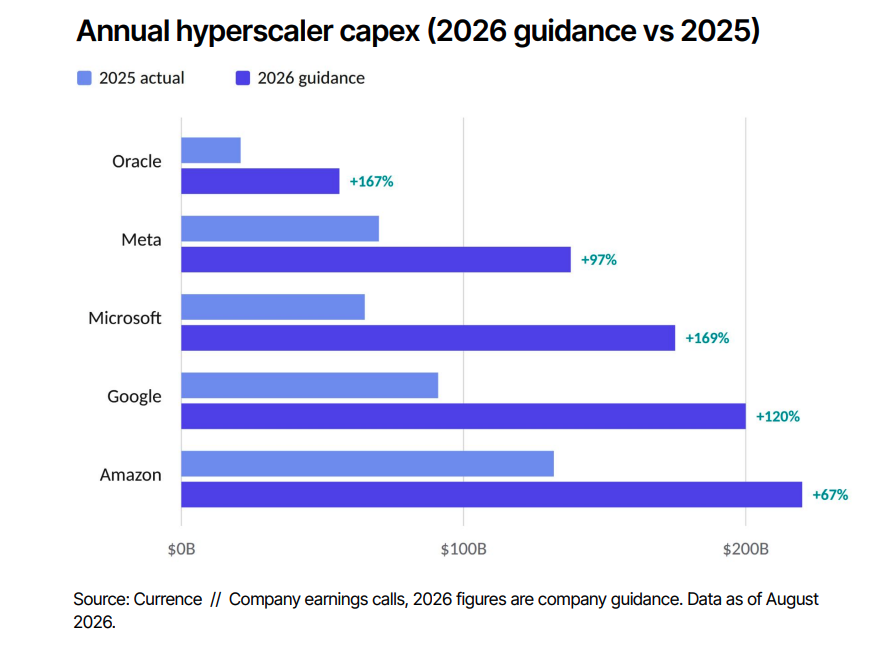
Five hyperscalers are on track to spend close to $790 billion on capex this year, roughly double their combined 2025 total. Microsoft guided up 169% year over year, Oracle by 167%, Google by 120%, and Meta by 97%. Amazon, the most cautious of the five, guided up 67%.
Prices are climbing for more than one reason. Labor shortages and stretching lead times are tightening supply for equipment like transformers, turbines, and switchgear, and suppliers gaining market share are gaining pricing power along with it.
Amazon raised its capex guidance by $20 billion and attributed the entire increase to memory prices, not new construction. Microsoft flagged roughly $25 billion of its own increase as a response to component pricing rather than expanded building plans.
The Currence research team expects that pressure to keep building. The lead times of high capacity turbines now run upwards of 4 years, up from two years in 2022, which means a turbine ordered today doesn't generate power until 2030.
The same squeeze is stretching across the rest of the equipment list, and $/MW costs are likely to keep climbing with it. A closer look at turbine lead times will be available to clients in the coming weeks.
The same megawatt costs more than it did a year ago
A meaningful share of the physical build sits outside hyperscaler capex entirely. Oracle discloses $260 billion in off-balance-sheet lease commitments against $56 billion in reported capex. That project debt sits at the joint venture level, split across participants, and never touches Oracle's own balance sheet. It's another way these numbers keep climbing without showing up cleanly in one place.
Currence's research team expects that pressure to keep building. The same lead-time squeeze already driving up memory prices is stretching across the rest of the equipment list, and $/MW costs are likely to keep climbing with it.
The short-term winners sit upstream of the data center itself: equipment providers, power conversion, grid technology, vertically integrated utilities, and on-site generation. The money going into this buildout isn't in question. What's less certain is how fast it turns into finished megawatts.
Labor is becoming the next constraint
Google and Meta have committed a combined $365 million to workforce training programs. Those programs will take years to produce trained workers, and they won't solve the labor constraint on their own.
The more scalable fix looks industrial rather than educational: more prefabrication, more modular construction, more automation on site. Utilities are likely to take on a larger role too, building dedicated training pipelines the way they already train linemen and plant operators.
Power and land used to decide where the next wave of data centers gets built. They still matter, but they're no longer sufficient on their own. The fastest-growing markets will be the ones that can also assemble the skilled workforce and supply chain to convert power and land into operating capacity.
Read the full report
The full Q3 2026 Data Center Outlook has a lot more in it, including findings on why 55% of the announced 2026-2030 pipeline is unlikely to come online, what actually kills a project versus what just slows it down, and the importance of social license in the era of the data center backlash.
The report draws on the same project-level data behind Data Centers & Power, Currence's product purpose-built for assessing powering strategies and project credibility. The platform covers 363GW of announced capacity, more than 30,000 US power projects linked to those data centers, an 8-factor credibility score on every project, and daily updates from news, permits, filings, and dockets.
More than 90 teams already run on the Currence engine, including Microsoft, bp, Baker Hughes, Southern Company, HSBC, BBVA, Siemens Energy, Shell, BHP, B Capital, Galvanize, and Mitsui.
If you're interested in learning more about our coverage, request a 20-minute call with our team.

.png)