
Climate tech VC hit $26.1bn in H1 2026, up 55%, but the AI buildout is now the single biggest force moving capital.
That's the central finding of our new H1 2026 Climate Tech Investment & Innovation Report.
The AI buildout is now the biggest driver of climate tech capital
Record power demand from AI infrastructure is pulling investment into the climate tech categories that serve it: grid tech, clean firm power, and low-carbon data center development.
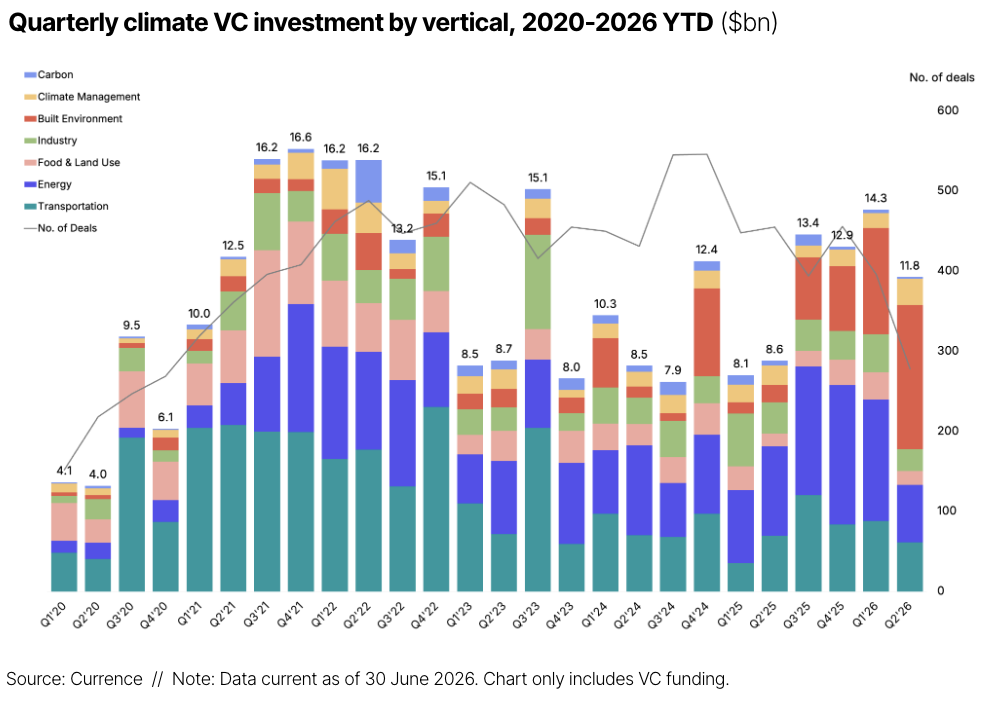
The Built Environment sector surged more than 800% (largely low-carbon data center developers) and overtook Energy as the largest vertical. Singapore developer DayOne raised $4.5bn in Series C, now the largest climate tech deal since 2020. AI infra company NScale raised $2bn. Low-carbon data centers made up 34% of total H1 investment.
This is what happens when hyperscalers need power that is fast, and defensible on emissions grounds. The developers who can deliver all three are raising at infrastructure scale, but note that it's still a rounding error in all data center investments. Grid tech had its best H1 yet for the same reason.
Series C hit a record, and it's starting to look like project finance
Series C rose nearly fourfold to $10.5bn. It hit a new record for the stage.
Still, almost two-thirds came from DayOne and NScale. But it's part of a bigger trend. Late-stage climate tech is increasingly funded on infrastructure terms: large checks, long time horizons, revenue visibility. The risk/return profile at Series C now looks more like project finance than venture.
For other stages, Series A was up 55% to $4.5bn. Nuclear, both fisison and fusion, comprised much of it. Proxima Fusion raised $470m for stellarator systems in Munich. Quaise Energy raised $134m for superhot geothermal drilling in Houston. These are unusually large Series A checks for deep tech, but hype around nuclear has grown.
Public markets are open again, reshaping private rounds
Fervo priced at $1.9bn and closed up 35% on debut. X-Energy hit $1bn, up 27%. Both are records for clean firm power IPOs. General Fusion completed a $1bn SPAC merger. The IPO window is open specifically for companies with real projects and policy backing. Their successes are eveninspiring a second wave of companies to make the leap into public markets, such as Form Energy and Holtec.
That is pulling forward investment at the early stage, at least for more expensive deeptech. Leaders are SPACing or moving into competitive later rounds. Investors are concentrating into a smaller number of early-stage nuclear and geothermal companies, pushing Series A check sizes up. Growth-stage investment fell 18% to $3.6bn as a result, with companies at that stage eyeing public exits over another private round.
Carbon equity funding collapsed, fuels funding fell by half
The Carbon sector is down 61% to its weakest half since 2020. It's been a tough few years for the sector, but this doesn't signal a full-fledged retreat. It's instead a move to a different type of financing: offtake. Amazon signed a 2-million-ton nature-based carbon deal, one of the largest NBS offtakes to date, and Frontier's carbon removal AMC is still active. So offtake and advance market commitments are replacing equity investment, particularly in carbon removal.
Meanwhile, low-carbon fuels fell 56%. Two reasons: US subsidy uncertainty as IRA tax credit stacks face political risk, and European buyers holding procurement decisions until 2027 policy reviews on SAF blending mandates. The near-term funding environment reflects uncertainty about which projects find bankable offtake before policy clarity lands.
Adaptation is becoming investable
Physical climate risk is becoming more visible, while satellite technology gets cheaper. For instance, satellite and obervation developer ICEYE raised $521m for radar satellites, the largest deal outside energy and transport in H1. The funding for the vertical, Earth Observation, tripled. Robotics foundational model and simulation startups raised nearly four times the next largest sector.
As disclosure requirements expand and extreme weather compounds, the tools to monitor, price, and respond to physical risk are drawing new growth-stage capital that used to go almost exclusively to mitigation.
What the concentration means for H2
Deal count fell 25% even as dollars surged, continuing the trend of consolidation and mega-deal acceleration. Ten deals took 42% of all funding. That concentration creates real brittleness — a few large deals slipping would change the H2 number materially.
The sectors to watch: fuels and carbon, where policy uncertainty is highest; nuclear and geothermal, where the IPO pipeline is biggest (and buzziest); and grid tech, which has had a strong run and will need continued hyperscaler procurement to sustain it.
The full report covers fundraising, stages, verticals, exits, and investor activity, including regional breakdowns and innovation trends by sector.
Download the H1 2026 Climate Tech Investment & Innovation Report.
Currence clients can access the full dataset and platform analysis on the platform here.
Frequently asked questions
Why did climate tech investment jump 55% in H1 2026?
The AI buildout is the primary driver. Record power demand from AI infrastructure is pulling capital into the climate tech categories that serve it: grid tech, clean firm power, and low-carbon data center development. DayOne ($4.5bn) and NScale ($2bn) alone account for a substantial portion of the year-on-year gain. The 55% increase is notable, but it reflects a small number of very large structural bets, not a broad market recovery. Deal count fell 25% in the same period.
What is driving low-carbon data center investment?
AI infrastructure developers face two simultaneous pressures: they need power that can come online fast, and they face scrutiny on pollution from the buildout of data centers. Low-carbon data center developers focusing on efficiency who can solve both — with credible power procurement, permitted sites, and clean energy offtake — are raising at infrastructure scale. DayOne's $4.5bn Series C is the clearest example. This is a macro trend driven by AI power demand, not a redefinition of what counts as climate tech.
Why did carbon equity funding collapse in H1 2026?
Carbon is down 61%, but corporate procurement is still active. What has shifted is the form capital takes: offtake and advance market commitments are replacing equity investment in carbon removal. This reflects a maturation of market structure, one arguably more fitting for the product itself.
What does the Series C record mean?
Series C hit $10.5bn, nearly four times the prior year. Almost two-thirds came from two data center deals. The broader pattern is that late-stage climate tech is increasingly funded on infrastructure terms, with large checks against visible revenue rather than technology bets. For investors, Series C now carries a risk/return profile closer to infrastructure finance than venture. For founders, demonstrated commercial traction is the new bar for accessing that capital.
Why are clean firm power IPOs performing?
Fervo (up 35% on debut) and X-Energy (up 27%) reflect public market appetite for assets with real revenue, real projects, and policy support. The AI buildout has made clean firm power strategically important to hyperscalers, grid operators, and policymakers simultaneously. The IPO window is open specifically for companies that have cleared that credibility bar.
What happened to low-carbon fuels funding?
Low-carbon fuels fell 56%. US subsidy uncertainty and European buyers holding off until 2027 SAF policy reviews are the two main factors. The underlying demand is mandated, i.e. SAF blending requirements imply a large procurement gap, but near-term funding reflects genuine uncertainty about which projects secure bankable offtake before policy clarity arrives.
What does rising adaptation investment signal?
ICEYE's $521m and the tripling of Earth Observation funding reflect a market treating physical climate risk as a present-tense planning input rather than a future scenario. As disclosure requirements expand and extreme weather compounds, monitoring, modeling, and response tools are drawing growth-stage capital that previously went almost entirely to mitigation.