
[Editor's note: Since this story was first published in CTVC, Sightline's weekly climate tech newsletter, the White House announced that most reciprocal tariffs would be paused for 90 days, although a 10% baseline and 25% tariff on steel and aluminum would still apply. That pause does not apply to China, which will see an increased tariff rate of 145%.]
We’ve got the climate tech take on the tariffs in this edition — breaking down the sector-by-sector impacts of the varying imports and reciprocal tariffs already announced.
Tariff tug-of-trade-war
Markets may still be waking up and reacting to Trump’s historic tariff announcement — but here at CTVC, we’re looking beyond the headlines to ask: what does a full-blown global trade war mean for climate tech? Buckle up, it’s a wild ride.
What happened
Last week, President Trump announced the most sweeping US tariff regime in over a century, slapping a baseline 10% tariff on nearly all imports and imposing "reciprocal tariffs" as high as 50% on countries with large trade surpluses or protectionist barriers (even uninhabited ones) starting this week. He also doubled down on previously announced tariffs: 25% on steel and aluminum, effective since March. Explore the math behind them here, see a full country-by-country breakdown here, and read the White House’s appendix here.
The full tariff list reads like a climate tech supply chain map — with major levies on imports from Southeast Asia, East Asia, and the EU. China was hit with a 34% tariff on top of existing duties, bringing its effective rate to 54%. The EU faces 20%. Canada and Mexico dodged the baseline tariffs (for now) under USMCA, but still face separate 25% duties on steel and aluminum, and 10% duty on energy products. Meanwhile, semiconductors, certain critical minerals, and some clean energy components were temporarily spared — though Trump has signaled sector-specific tariffs could be next.
Markets didn’t buy the logic: The move shocked global stock indices and drew swift condemnation from allies and trade partners. The S&P 500 had its worst week since March 2020 (although First Solar is up). Oil prices fell sharply (especially amid news that OPEC is boosting production). Meanwhile, the EU called it a “major blow” to the world economy, and China hit back with economic weapons beyond tariffs — both a 34% tariff on US goods and rare-earth export controls — as did Canada, with 25% retaliatory tariffs on US vehicles.
Trump officials say this is part of a broader plan to reshore manufacturing and create a “self-reliant” American economy, even as economists warn of stagflation, retaliation, and a looming global recession.
Why it matters
At face value, the tariff blitz is Trump’s latest salvo in a long-running effort to rewrite the rules of global trade. But an escalating trade war could be uniquely disruptive for climate tech.
The ongoing energy transition is, at its core, an industrial transition — and that means it depends on global trade. The idea of US supply chain manufacturing independence is popular in theory and a bipartisan priority, but through different means: Biden aimed to boost (clean) domestic manufacturing and critical minerals by expanding DOE’s MESC and adding domestic content bonuses to Inflation Reduction Act tax credits, while Trump is taking the trade route. But the reality of standing up supply chains is complex, capital-intensive, and slow. Tariffs may eventually spur domestic production, but in the short term they raise costs, create volatility, and stall momentum.
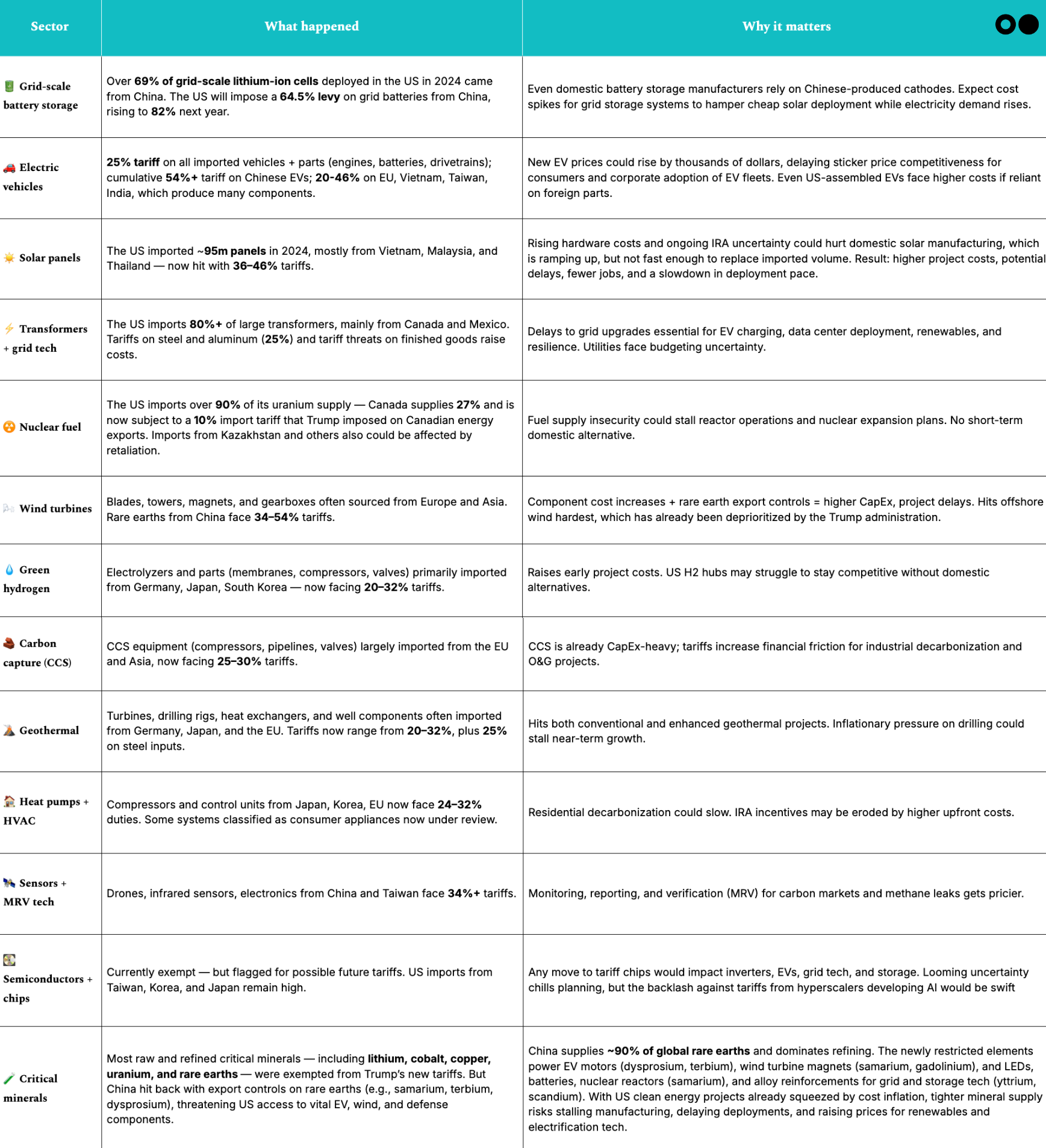
US tariffs x climate tech sectors
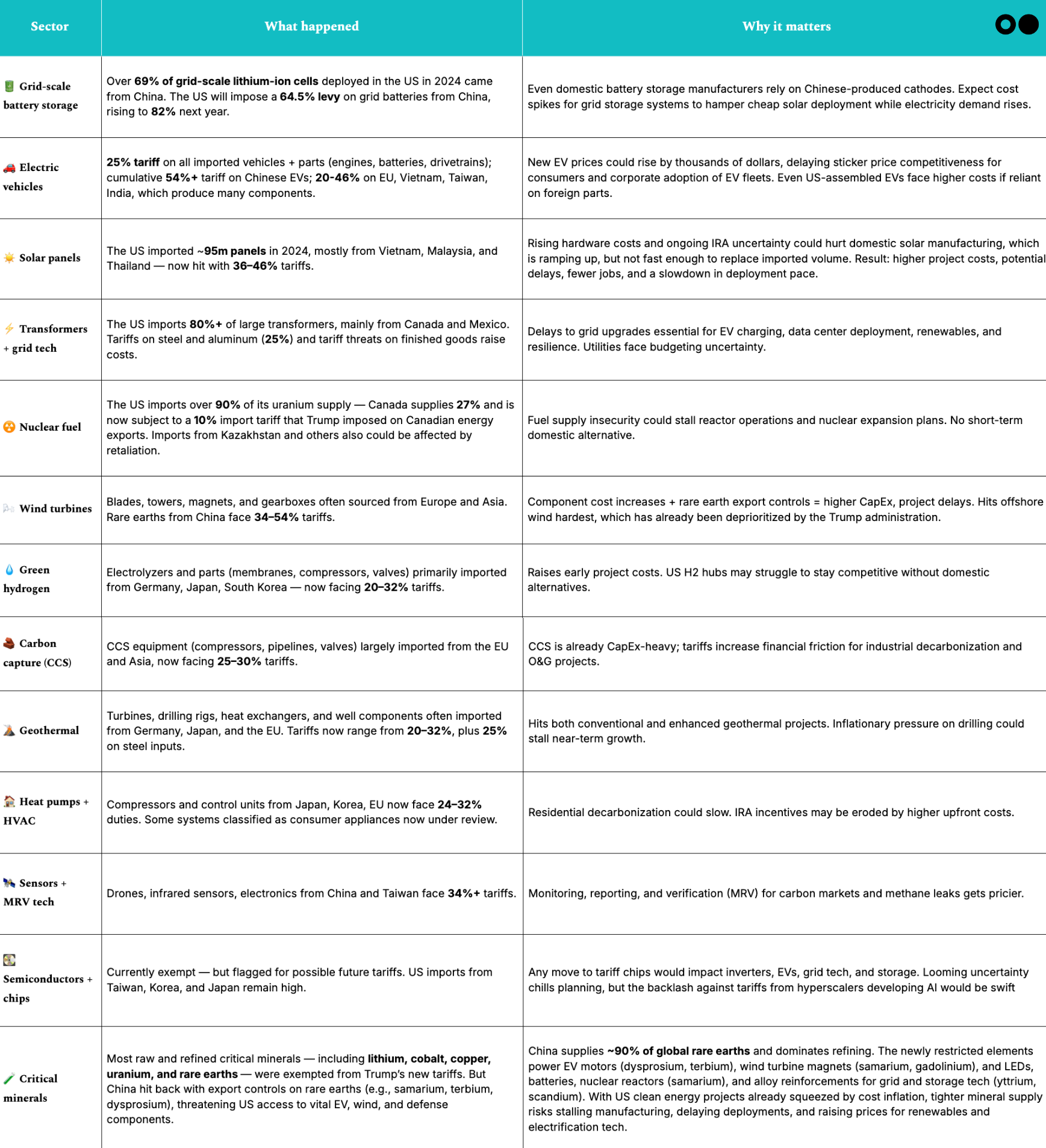
Projects with vertically integrated domestic supply chains might benefit — but even they face higher costs for components, labor, and debt financing. Meanwhile, clean energy developers and utilities are already navigating congressional uncertainty around IRA subsidies. Projects are being paused, delayed, or pulled entirely. Add tariff-driven cost spikes and fractured global sourcing, and the risk premium on new development is climbing fast.
One possible upside? If tariffs tip the global economy into a downturn, it could depress demand for fossil fuels — a backdoor boost for clean energy, though a rough one. At the same time, with the EU and UK increasingly wary of relying on US LNG after pivoting away from Russian gas post-Ukraine invasion, trade realignments could further accelerate Europe’s decarbonization push.
What’s next
⚙️ Projects are caught in the crossfire. Nearly every major decarbonization technology depends on imported components now facing steep tariffs. While vertically integrated US manufacturers may have a buffer, they’re still exposed to rising costs, procurement delays, and growing geopolitical risk. China’s rare earth export controls and other countries’ retaliatory moves are already squeezing supply chains. And for long-lead projects like offshore wind or geothermal, tariff volatility upends the stable pricing, predictable inputs, and long-term signals they need to move forward.
💸 Capital is cooling just as momentum should be building. Developers and utilities were already navigating IRA uncertainty in Congress. Now, with tariff costs stacking up and global trade fracturing, the risk premium on clean energy projects is rising. Utilities in the Pacific Northwest and Northeast are petitioning regulators to defer pass-through costs on imported electricity and fuels.
🧭 Some climate innovation will move elsewhere. The IRA helped trigger a wave of climate activity in the US — but climate VC funding has fallen from 2022 highs in the US. Rising costs, policy uncertainty, and research disruptions are making other markets more attractive. China and the EU are doubling down on industrial policy, carbon border adjustment mechanisms, and green export credit support. If the US slows down, it risks losing ground in the global race for tech leadership, talent, and manufacturing capacity.
🫱 Don’t panic — but do pay attention. The energy transition doesn’t run on election cycles. In theory, if the US can weather the disruption, new capital could flow into domestic manufacturing and help rebalance supply chains. And market forces — from AI to grid demand — will keep pushing toward renewables. The ZIRP climate boom followed COVID and supply chain crises, after all. Still, this decade is critical for preventing worst-case climate scenarios, and delays carry their own kind of risk.


.png)