We’ve been hearing murmurs (okay, more like shouts) about just how rough the shipping slowdown might get as new US tariffs start to bite. West Coast ports, the main entry points for container ships from China, are seeing a big drop in the number of containers arriving. The Port of Los Angeles is expecting a 35% decrease in container traffic next week compared to the same time last year, as LA port director Gene Seroka told the New York Times. Retailers are pulling back on imports and ships are returning across the Pacific with empty holds, and about a quarter of the ships scheduled to dock in May have canceled due to the lighter volume.
This isn’t just a short-term blip. With long order lead times — retailers and manufacturers typically place factory orders for Halloween and Christmas right about now — there’s a significant lag between policy and port activity. And with container ships taking 20–40 days to cross the Pacific, we may see a near standstill by mid-May.
A global slowdown in trade, driven in large part (but not exclusively) by US tariffs, means choppy seas ahead for the industry that carries almost 90% of international goods: maritime shipping. At the same time, the industry’s governing body, the IMO, just passed the world’s first carbon price as shipping companies race to decarbonize.
As with everything, this got us thinking. If ships are sailing with less cargo, with less route certainty, and under tighter emissions rules, how do they stay profitable? Seems like one of those innovate-or-die scenarios—get more efficient, stay agile, find the opportunities bubbling to the surface, leave the past in your wake.
1. Efficiency gains, from bubbles to blades.
Remember when those air deflectors started appearing on the tops of cabs of semi-trucks? A curiosity at first, I remember thinking they looked weird, but changed my tune when I found out they make the trucks 5-10% more fuel-efficient, saving the trucker thousands of dollars per year. Same thing is going on in shipping — finding those efficiency gains to save on fuel costs and squeeze more out of existing fleets. The last thing you want to do is send out empty or lightly loaded ships.
Meanwhile, the IMO regulations center around cutting CO2 emissions per unit of transport work (ton-miles or ton-nautical miles). So how can you do this? Retrofits or upgrades to make ships more efficient, for one. Hull and propeller upgrades are an obvious starting point. Cleaner and more aerodynamic designs reduce drag and improve fuel efficiency. In fact, similar to the truck air deflection systems, air lubrication systems for ships blow bubbles across the hull to reduce friction. Additionally, advanced hull coatings that reduce friction with water are also making a dent, helping ships glide more smoothly.
And then there’s wind. ⛵Wind-assist technologies—we know, sails—like rotor sails and rigid wings are making a comeback, but this time high-tech. These systems can help cut fuel use by capturing the oldest renewable energy source around. Combine that with hull and coating improvements, and you’ve got a modern vessel that runs leaner and cleaner.
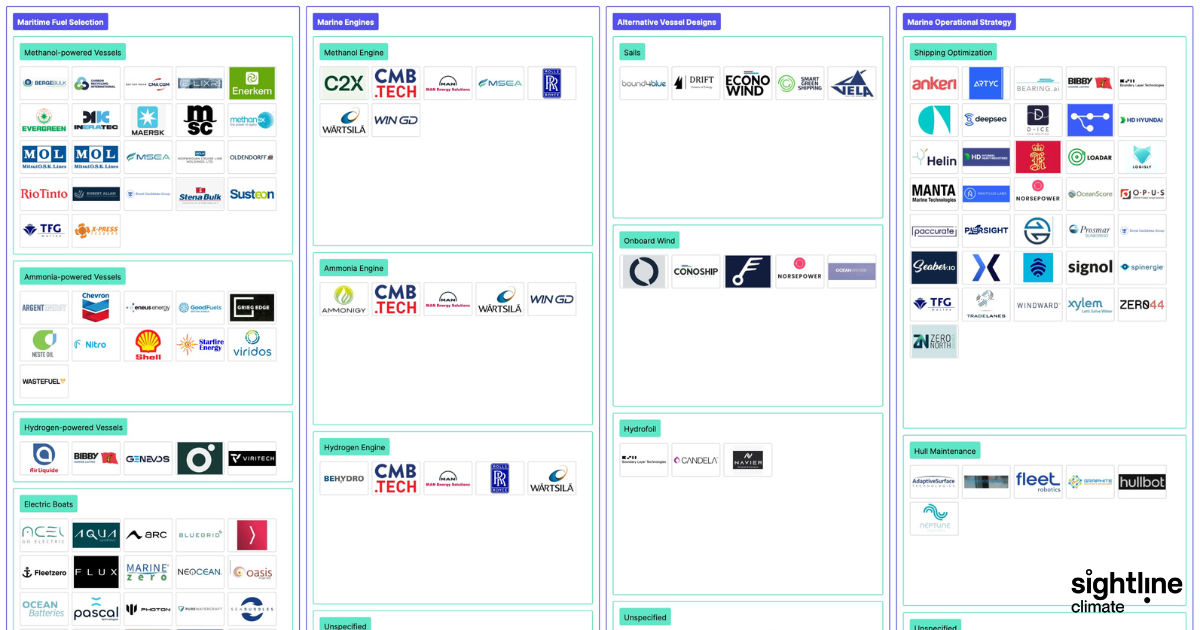
Look here at part of our Maritime market map to see all the companies pushing for efficiency gains across the fleet (and see an even deeper one on the platform).
.png)
2. Fill ‘er up — new fuels for lots of knots.
Efficiency upgrades are only part of the story. Many shipping operators are now rethinking the fuel mix entirely. The industry is moving away from bunker fuel toward cleaner alternatives, and there’s no shortage of experimentation.
Bio-methanol, ammonia, hydrogen, and LNG are all in the mix, alongside hybrid propulsion systems that let ships switch between diesel engines, batteries, and electric motors based on route and load. Energy-efficient propulsion designs — like dual-fuel engines or systems that can tap waste heat for power — are becoming more common.
And it’s not just theory. Companies like Maersk are already deploying these technologies. Our fuels analyst Oliver recently delivered Sightline analysis at a launch event for one of Maersk’s new methanol-fueled ships, a sign that next-gen propulsion is moving from the lab to the dock.
But as always, it’s a systems challenge — ammonia-powered vessels are only as functional as their fuel source is available. You can look at the ammonia project deployment on the Sightline platform here. As you can see, well, still pretty sparse.
3. The sea meets the cloud.
Beyond physical upgrades, the digital layer is becoming even more critical. Route planning tools can optimize fuel use, avoid weather delays, and stay compliant with regulations. Freight monitoring systems help ensure ships sail at capacity, while predictive maintenance software flags issues before they become costly problems. Some companies are even building digital twins of their vessels to simulate performance and identify efficiency improvements across entire fleets. Plus, XOCEAN, a monitoring solution for maritime ops, had one of the biggest deals from Q1’25. the last quarter.
Software investments, obviously cheaper than the hardware ones, can offer some of the highest ROI with the least overhaul amid tight margins.
.png)