

A new product from Currence fills the missing layer in data center intelligence: project-by-project credibility on the AI buildout, so utilities, financiers, and suppliers can make better bets on what gets built.
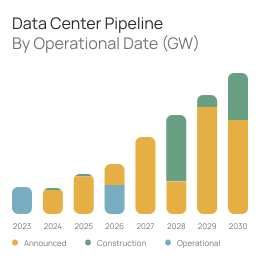
Announced capacity for 2026 points to another year of explosive growth for data centers. But according to our analysis, 30 to 50% of the announced US pipeline is unlikely to come online before the end of the year.
A 1GW data center stranded for six months is roughly $18bn of foregone infrastructure rent, and over $30bn including the AI services stack on top. That number belongs in every utility plan, every OEM order book, every project finance underwrite, and every developer's site economics.
This question, which specific projects are real, has been almost impossible to answer with rigor. Real estate intelligence ends at the fence line. Power research ends at the substation. Regulatory products give you filings without the project context around them. Nobody connects the data center to the power, equipment, and permits necessary for project credibility.
In this moment of growth and uncertainty, Currence (formerly Sightline Climate) is launching Data Centers & Power, a new data and research product that scores which hyperscale projects will get built.
The product and how you can use it
Currence tracks 1,000+ hyperscale data center projects (>50MW) announced since 2024, scored across eight credibility factors, and connects each one to powering models, equipment contracts, permits, and policy actions that determine whether it gets built.
Powering models are classified at the project level and linked to 35,000+ US power generation and storage projects.
Those fields are continuously updated by our AI engine which ingests and validates from thousands of sources. Our expert research team layers taxonomies and models based on more than 75 cumulative years tracking energy markets.
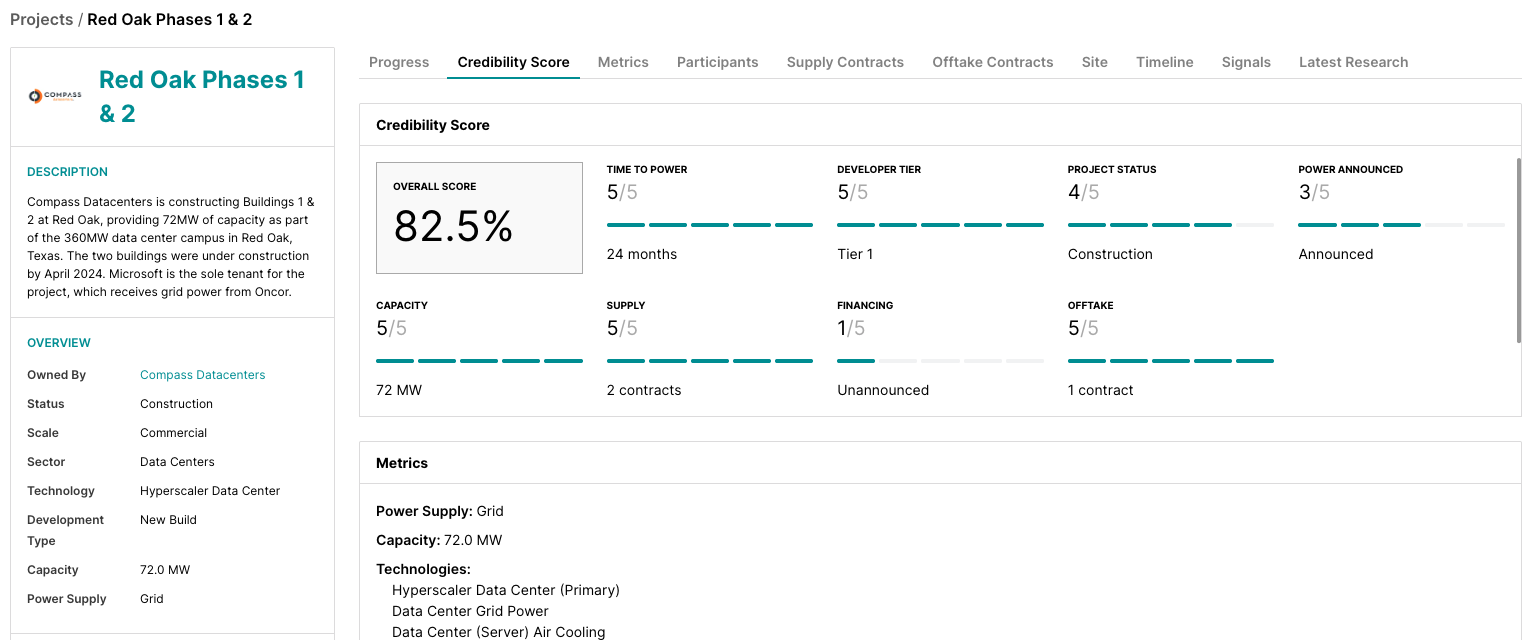
The core of DC&P is a project-level answer to the question every buyer is asking: is this real? Is the buildout itself real? We score 99% of 1,000+ projects on eight credibility factors, with an evidence-backed readiness assessment underlying every record.
Of all the announced data centers, only a fraction have a viable site, secured power, capital, and permits in motion. The credibility score separates those from the press releases, project by project, so a utility plans generation against load that is real and a lender underwrites a pipeline that will materialize.
If you're a utility deciding which developer to sign a PPA with, an OEM hunting for unsupplied projects, a developer benchmarking the competition, or an investor separating real load from press releases, this product is for you.
What makes this different from other intelligence products
DC&P has four main advantages that other intelligence products lack: credibility, powering model, equipment contracts, and permits and filings.
1. Credibility. Eight factors covering site control, power procurement, capital, permitting progress, developer track record, and more. Drill from the headline score into the evidence behind it.
2. Powering model. Every project is classified by how it intends to run: grid, behind-the-meter, hybrid, clean firm, or bridge. On-site and hybrid sites are under 10% of projects but close to half of announced capacity, and nearly half of all projects have not disclosed a power strategy at all.
3. Equipment contracts. We capture the equipment at the contract level: turbines, BESS, solar, nuclear, backup, and cooling, with vendor, model, MW, and unit count. OEMs use this to size addressable market and find unsupplied projects.
4. Permits and filings. Air quality permits and regulatory filings can provide the clearest signals that a project is slipping.
The result is a connected record you can interrogate: which projects lead, which are stalling, and the specific reasons why.
Who uses Data Centers & Power
DC&P is the intelligence layer for the AI-power buildout. DC&P supports planning, procurement, underwriting, and benchmarking decisions across four buyer groups.
Utilities and IPPs
Utilities and independent power producers need to plan generation, transmission, distribution, and PPAs around load that is actually going to show up. They use the credibility score and powering-model classification to decide which developers to plan around and which announcements to discount.
OEMs and equipment providers
Turbine, switchgear, cooling, BESS, and nuclear suppliers use the equipment contract data and supplier leaderboards to size addressable market, identify unsupplied projects, benchmark against competitors, and set pricing.
Capital allocators
Infrastructure investors, project finance banks, and lenders use DC&P to underwrite which projects are bankable rather than speculative. Credibility scoring concentrates diligence on projects with real readiness signals, and the cost-of-delay model quantifies the downside.
Hyperscalers and developers
Hyperscalers, co-locators, and developers benchmark their own power strategy, equipment choices, and site economics against competitor projects, and separate executable capacity from speculative pipeline across the market.
What this product enables
Building new power takes years. So the smart money is buying existing power instead. Companies are taking an energy hoarding strategy — take-privates of existing power assets (BlackRock/GIP/EQT's AES acquisition is the latest), regulatory capture in favorable state PUCs, project company acquisitions instead of greenfield build.
The data centers that get built are increasingly the ones employing these powering strategies. Tracking the energy hoarding playbook is now as important as tracking the buildout itself.
Get full access to our research and data
Currence Data Centers & Power is live now for existing customers and qualified new buyers.
Reach out to see how it supports planning, procurement, diligence, and strategy.
Talk to our team · Already a client? Log in here.
.png)