Transportation produces roughly a sixth of global greenhouse gas emissions, but the toughest part isn’t commuter cars — it’s the remaining heavy, far-going, always-on segments: aviation, long-haul trucking, and maritime shipping.
Here, energy density rules. Batteries shine in small, short journeys, yet become weighty and range-limiting as missions lengthen or payloads grow. Aircraft and oceangoing vessels need compact energy at massive scale, at exactly the intersection where today’s electric options still struggle. Meanwhile, hydrogen helps in some niches, but storing and moving it is hard. That’s why clean, drop-in fuels — liquid hydrocarbons made with low-carbon inputs — are drawing serious attention. They fit today’s tanks, pipes, and engines, letting us slash lifecycle emissions without rebuilding the world’s fueling hardware from scratch.
Kicking the (gas) can: demand keeps rising
“Use less” is a tough sell when trade, e-commerce, and travel access keep growing. For three decades, transport emissions climbed steadily. Offtakers can’t just switch off growth, so they must switch fuels. But price sensitivity is intense. Airlines and shippers operate on razor margins; even small fuel cost deltas affect routes, schedules, and freight rates. Meanwhile, energy security pushes governments and companies to diversify away from imported fossil fuels — another nudge toward domestic clean molecules.
Three reasons alternative fuels are essential
- Infrastructure lock-in: The world is built for hydrocarbons. Drop-in alternatives leverage existing tanks, pipelines, engines, and certification regimes.
- Price sensitivity: Commoditized fuels demand tight cost control; parity remains the prize.
- Security and resilience: Domestic clean fuel supply reduces geopolitical risk and price shocks.
Fuel fundamentals: Hydrocarbons 101
In simple terms, a fuel is any substance that reacts with another to release energy. Most modern fuels are hydrocarbons: chains of carbon and hydrogen atoms, sometimes mixed with small amounts of oxygen or nitrogen. These chains can vary in length, structure, and composition, even within the same category of fuel, which is why gasoline behaves differently from diesel or jet fuel. Fuels release energy when they react, usually by combustion.
The hydrocarbons we burn today, like gasoline and diesel, were forged deep underground over millions of years. Alternative fuels, by contrast, aim to recreate those same energy-rich molecules in a matter of hours or days. Instead of drilling for ancient carbon, clean fuels repurpose modern sources such as biomass, renewable hydrogen, and captured CO₂, assembling them into hydrocarbons through advanced chemistry and biology — using catalysts for conversion, microbes for fermentation, electrolysis to split water for hydrogen, and solvents or acids to extract bio-oils. The goal is simple but ambitious: produce drop-in fuels that behave like fossil fuels, but without the fossil footprint. The trick is doing all this cheaply, cleanly, and at scale — a three-way optimization that has humbled many a balance sheet.
DIY Hydrocarbons
First things first: Alternative fuels come in two types. Biofuels start with biomass or waste, like used cooking oil, animal fats, crop oils, sugarcane, corn, agricultural residues, and forestry waste. Electrofuels (e-fuels) use electricity to combine ideally green hydrogen with carbon from captured CO₂, producing synthetic hydrocarbons identical or near-identical to fossil fuels.
These low-carbon fuels are only as sustainable—and as affordable—as the ingredients that make them. The cost, availability, and emissions footprint of inputs like clean hydrogen, biomass, and captured CO₂ ultimately determine both the price competitiveness and climate performance of biofuels and electrofuels.

Tech pathways
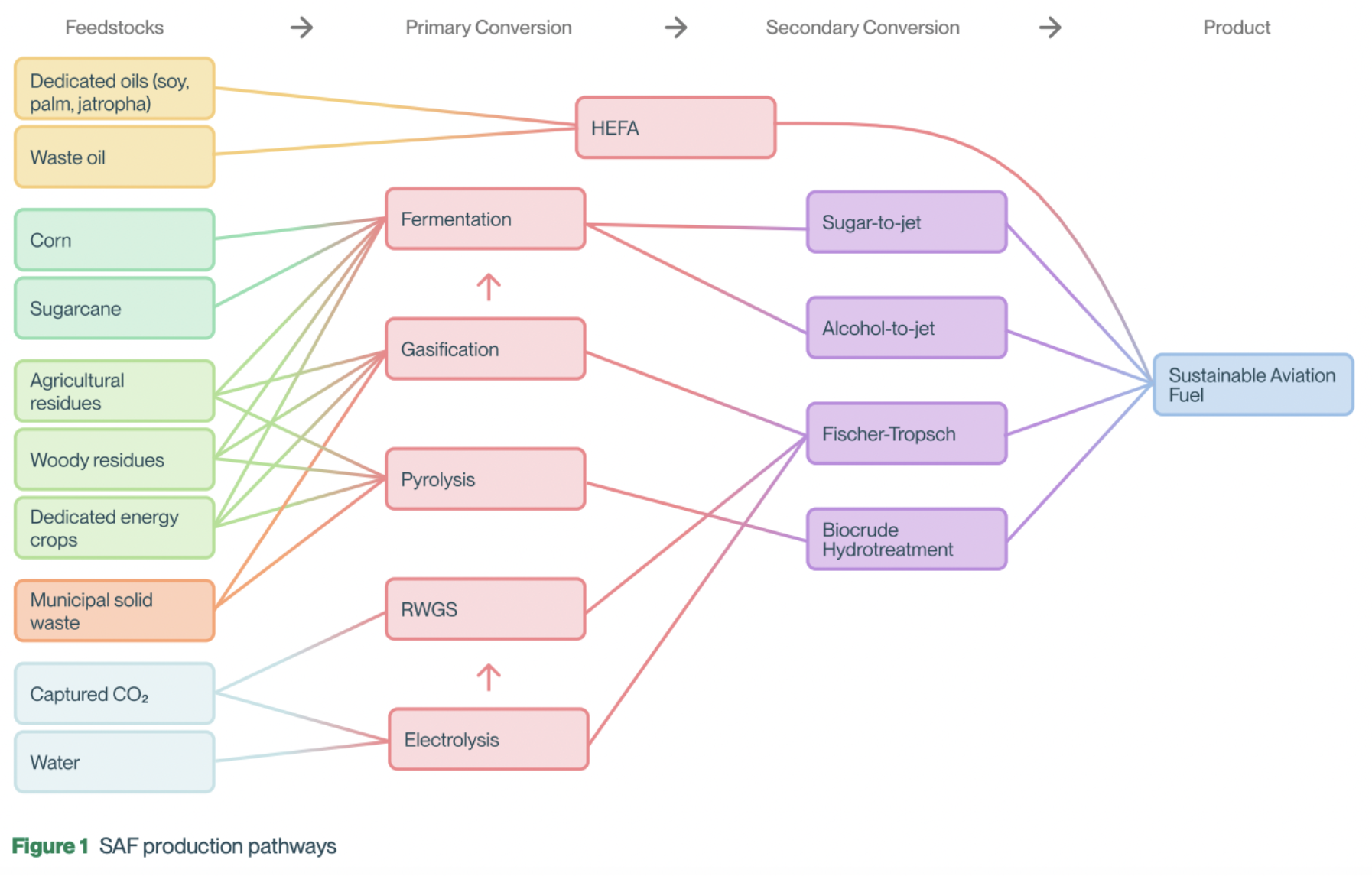
Across both biofuels and e-fuels, there’s more than one way to make a hydrocarbon. Each production pathway takes a different route from raw material to fuel, with its own mix of benefits and trade-offs.
Biofuels
1. Vegetable and Waste Oils
How it works: Waste oils and fats are converted into fuels using hydrotreatment, a chemical process that introduces hydrogen to remove impurities and oxygen. This yields high-quality hydrocarbons suitable for transportation fuels. Two major products emerge:
- HEFA (Hydroprocessed Esters and Fatty Acids): Used to produce sustainable aviation fuel (SAF).
- HVO (Hydrotreated Vegetable Oil): A renewable diesel chemically identical to its fossil counterpart.
The tough part: Hydrotreatment technology is mature, but feedstock supply remains the choke point. Collecting and transporting waste oils at scale is costly, while growing high-oil crops (like soy or palm) introduces land-use, deforestation, and food-security concerns.
2. Algae Biomass
How it works: Oil-rich microalgae or seaweeds are cultivated — often in photobioreactors or open ponds — and then harvested for their lipids, which are extracted and refined through the same hydrotreatment processes used for vegetable oils.
The tough part: Algae fuels have proven difficult to commercialize. Maintaining contamination-free growth systems and efficiently extracting oils are technically complex and expensive steps. Many major energy companies, including BP, Shell, Chevron, and ExxonMobil, have wound down their algae programs after years of R&D.
3. Sugar Crop Biomass
How it works: High-sugar crops such as corn or sugarcane are fermented into ethanol and other alcohols. These can be used directly as gasoline additives or upgraded into jet fuel through alcohol-to-jet (ATJ) processes.
The tough part: “Grow-to-fuel” models compete with agriculture for land, water, and biodiversity. In Cleantech 1.0, heavy subsidies for corn ethanol boosted early adoption, but low yields and volatile crop prices made large-scale production economically unsustainable.
4. Cellulosic Biomass
How it works: Cellulosic biomass, such as agricultural residues, forestry waste, or dedicated energy crops, can be converted into fuels via pyrolysis, which heats biomass in the absence of oxygen to create biochar, bio-oil, and syngas. The liquid and gaseous fractions can then be refined into transportation fuels.
The tough part: Feedstock collection and preprocessing are energy- and cost-intensive. Pyrolysis itself requires high temperatures, making it difficult for cellulosic fuels to compete economically with fossil fuels. The result: high costs, low margins, and slow commercial uptake.
Electrofuels (E-Fuels)
1. Ethanol Electrofuels
How it works: Instead of fermenting sugars, CO₂ is directly converted into ethanol and related alcohols using microbial or catalytic processes powered by renewable electricity. These alcohols can be used as fuel additives or converted into SAF via ATJ technology.
The carbon source is typically captured CO₂, from industrial point sources today, and eventually from direct air capture (DAC) for truly carbon-neutral production.
The tough part: Ethanol e-fuels are still early-stage. Few facilities operate at commercial scale, and the process is both CO₂- and energy-intensive. Captured carbon remains scarce and costly, and the need for renewable, low-cost electricity makes energy economics critical.
2. Syngas Electrofuels
How it works: Syngas, a blend of carbon monoxide (CO) and hydrogen (H₂), can be synthesized by splitting CO₂ and H₂O through electrolysis, removing oxygen atoms and recombining the remaining molecules. The resulting syngas feeds into the Fischer–Tropsch (FT) process, producing synthetic hydrocarbons like diesel, jet fuel, or gasoline.
The tough part: E-fuel production is energy-hungry and highly dependent on low-cost renewables. Both CO₂ and H₂ feedstocks are expensive and difficult to transport. Since syngas is gaseous, it’s most efficient to site FT synthesis plants directly at production hubs to minimize logistics losses.
Fuel Outputs and Applications
The outputs from biofuel and e-fuel processes differ widely in chemistry and performance, influencing where they fit best across transportation sectors. While some can be used directly, others require further refining or blending to meet safety and performance standards.
Sustainable Aviation Fuels (SAFs)
What they are: SAFs mimic the properties of Jet A (the main aviation fuel) and can be blended or used directly in existing aircraft.
Applications: ✈️ Aviation
Biofuel innovators: Aemetis, Aljadix, CleanJoule, Firefly, Fulcrum, NWABF, SkyNRG, World Energy
Electrofuel innovators: Air Company, Arcadia eFuels, Carbon Engineering, Dimensional Energy, HIF Global, Ineratec, Infinium, LanzaJet, OXCCU, Prometheus, refuel.green, Synhelion, Twelve
Diesel
What it is: A heavy fuel ignited by compression, used in trucking, maritime, and industrial applications.
Applications: 🚚 Trucking, 🚢 Shipping, 🚜 Heavy industry
Biofuel innovators: Aemetis, World Energy
Electrofuel innovators: Arcadia eFuels, Ineratec, Synhelion, Twelve
Biodiesel
What it is: A biologically derived fuel chemically distinct from petroleum diesel. It typically blends at 5–10% (B5–B10) with fossil diesel.
Applications: 🚚 Trucking, 🚢 Shipping, 🚜 Industrial vehicles
Innovators: Biojet, GoodFuels, Paradigm Fuels, UPM
Gasoline
What it is: A light hydrocarbon fuel used in cars, small trucks, and boats, compatible with existing infrastructure.
Applications: 🚌 Light- to medium-duty vehicles
Biofuel innovators: Sundrop Fuels, Verde Clean Fuels
Electrofuel innovators: HIF Global, Prometheus
Ethanol
What it is: An alcohol fuel blended with gasoline to lower carbon intensity or upgraded into jet and diesel substitutes through chemical conversion.
Applications: ⛽ Blending, conversion feedstock
Biofuel innovators: Aemetis, Blue Biofuels, Enerkem, Paradigm Fuels, Tarkim
Electrofuel innovators: Air Company, LanzaTech, Susteon
Syngas
What it is: A gaseous intermediate containing hydrogen, carbon monoxide, methane, CO₂, and water vapor. It’s the backbone feedstock for producing other low-carbon fuels, including renewable diesel, gasoline, and SAFs.
Applications: ⛽ Conversion feedstock
Biofuel innovators: AquaGreen, Red Rock Biofuels
Electrofuel innovators: Dimensional Energy, Ineratec, SeeO₂ Energy, Sunfire, Synhelion, Twelve
Offtakers and compatibility
We tuned engines for fossil fuels; now we’re changing their diet. Some options (HVO, HEFA-SAF) slide into existing engines and logistics. Others (methanol or ammonia for ships) may cut operating costs but demand costly newbuilds or retrofits. Offtakers weigh capex to switch against opex to run plus carbon liabilities.
Aviation case study
Major airlines are stepping up — not only through purchase agreements but also by investing directly in production-technologies for sustainable aviation fuel (SAF). For example, United Airlines launched the Sustainable Flight Fund (via United Airlines Ventures) in 2023 with more than US$200 million in commitments from United and partners. They recently made strategic investments:
- In February 2025, United invested in Heirloom (a direct-air-capture company) gaining rights to purchase up to 500,000 tons of CO₂ for use in future SAF or storage.
- In May 2025, the fund invested in Twelve, a company using power-to-liquid technology (CO₂ + water + renewable electricity) to generate SAF. The plant (“AirPlant One” in Moses Lake, WA) is expected to begin production in 2025 with ~50,000 gallons annually, backed by a 14-year, 260 million-gallon contract with a European airline group.
To ensure SAF is widely available across airline routes, the industry now recognises that collaboration is required not just between airlines, but also across energy producers, feedstock suppliers, airports, regulators and governments. However, the scale of deployment remains modest and cost/pricing remains the major barrier.
The economics of fuel switching
In fungible fuel markets, the first barrier is price. E-fuels convert electricity into liquid form via several steps, each with losses, so electricity cost dominates. Biofuels can be cheaper where waste lipids (and policy incentives) abound, but demand quickly soaks limited supplies. Over time, scale, process efficiency, and learning curves can narrow the gap. Meanwhile, many offtakers accept a green premium to meet mandates or brand goals, sometimes passing modest costs to customers. Policy can change the cost curve here.
Government policy and subsidies
In the US:
- Clean Fuel Production (45Z): Effective Jan 1 2025 → Dec 31 2029 (extended by OBBBA 2025).
- Rate based on carbon intensity (CI): ≈ $0.20 / kg CO₂e base ( $1.00 with wage/apprentice bonus ); up to ≈ $1.75 / gal for ≥ 50 % CI cut.
- From 2026: feedstocks must originate in US/Canada/Mexico.
- SAF no longer has a special bonus rate.
- Carbon Capture & Use (45Q): Eligible through 2033; cornerstone for e-fuel CO₂ feedstock.
- $85 / t stored; $60 / t used in fuels.
- Direct Air Capture bonus $180 / t stored or $130 / t used.
- Clean Hydrogen (45V)
- Applies 2023 – 2033; key input credit for e-fuels and renewable diesel.
- Up to $3 / kg H₂ for ≤ 0.45 kg CO₂e / kg H₂.
- Credit Stacking Rules (OBBBA 2025)
- No double-counting emissions reductions.
- 45Z ↔ 45Q can’t stack on same fuel volume.
- 45V ( hydrogen ) may stack upstream with 45Z ( finished fuel ).
- PTC/ITC renewable power credits still stackable.
- Tighter ownership + feedstock origin rules.
- Renewable Fuel Standard (RFS): in force through 2030; 36 B gal target.
- California LCFS: tightening CI targets to 2035; credit ≈ $60–70 / t CO₂e.
In the EU:
- ReFuelEU Aviation: SAF blend mandate 2 % by 2025 → 20 % by 2035 → 70 % by 2050.
- FuelEU Maritime + EU ETS expansion: Aviation and shipping covered since 2024.
- 🔗 ReFuelEU Aviation
- 🔗 EU ETS 2025
Global regulations:
Beyond price, you need permission. Standards bodies and regulators set blending limits to preserve safety, performance, and durability. Aviation pathways (ASTM D7566 annexes) define what can fly and at which blends; road fuels navigate national specs and emissions rules. Policy drivers—CORSIA, U.S. RFS and California LCFS, EU ETS and ReFuelEU—translate climate goals into demand signals and credits.
ICAO CORSIA
- 125 + countries participating.
- Accepts SAFs meeting CORSIA Sustainability Criteria.
- Alignment with U.S. EPA + EU ETS.
- 🔗 ICAO CORSIA
Four hard limiters to scale
- Competing on cost: Fossil fuels remain cheap and deeply amortized.
- Feedstock supply: Sustainable lipids and residues are finite; green H₂ and DAC CO₂ are still scaling.
- Tech readiness: E-fuels are multi-step and capital-intensive; reliability must prove out.
- Energy demand: Turning electrons into molecules needs lots of clean power.
Geography and co-location
You can’t wish away physics: gases are hard to ship; hydrogen especially so. The best economics show up where wind/solar, water, grid access, CO₂, and offtakers cluster—reducing pipelines, compression, storage, and transport emissions.
Why it still (probably) works
- Incentives: Smart policy narrows cost gaps and underwrites first-of-a-kind plants.
- Regulatory momentum: Clearer rules unlock higher blends and bankability.
- Tech breakthroughs: Better catalysts, direct hydrogenation of CO₂ and H₂, improved separations, and thermal integration lower capex/opex.
- Engine evolution: OEM tweaks expand compatibility windows and raise approved blend ceilings.
- Strategic partnerships: Long-dated offtakes + JV equity = financeable projects.
- SAF first: Airlines accept premiums; early wins spill into diesel and gasoline later.
Fueling carbon-free transport: a practical playbook
- Build a portfolio, not a bet: Mix near-term HEFA/HVO with pilot e-fuels; diversify feedstocks.
- Site for molecules, not maps: Prioritize co-location with renewables, water, CO₂, logistics, and buyers.
- Contract to bankability: Combine fixed-for-floating PPAs, hedged power, take-or-pay offtakes, and floor-price credit structures.
- Engineer for drop-in first: Where possible, stay within existing standards to speed certification and uptake.
- Count carbon precisely: Use ISO-aligned LCAs; optimize Scope 1–3, not just tailpipe.
- De-risk supply chains: Lock feedstocks with long-term agreements; design for multi-feed flexibility.
- Stack policy smartly: Model 40B/45Z vs. 45Q/45V pathways and regional credits; avoid double-counting traps.
- Design for uptime: High on-stream factors matter more than heroic nameplate claims.
- Plan for next gens: Modular units, revampable reactors, and software-defined operations absorb learning.
FAQs
1) What makes a fuel “drop-in”?
It meets existing specifications so it can be blended or used directly in current engines and infrastructure without hardware changes.
2) Why not just electrify everything?
Energy density and duty cycles. For aircraft and oceangoing ships, today’s batteries add weight and reduce range; drop-in liquids keep performance while cutting lifecycle carbon.
3) Is using captured CO₂ really “green”?
Using point-source CO₂ delays emissions; DAC-sourced CO₂ can achieve carbon-neutral cycles when paired with renewable power and low-CI hydrogen.
4) Are biofuels sustainable at scale?
They can be—if feedstocks avoid land-use change and biodiversity impacts. Waste lipids are best but scarce; residues help, yet logistics add cost.
5) How close are electrofuels to parity?
Power price is king. With cheap renewable electricity, high-efficiency electrolyzers, and improved synthesis, costs are falling—but broad parity still needs scale and policy support.
6) Why do airlines move first?
SAF integrates with existing jets and fuel systems, regulations create demand, and customers tolerate modest green premiums—making aviation the tip of the spear.
7) What’s the difference between renewable diesel and biodiesel?
Renewable diesel (HVO) is drop-in and engine-friendly. Biodiesel (FAME) usually blends at 5–10% due to material and performance constraints.
8) How important are hubs?
Critical. Co-locating H₂, CO₂, renewables, water, and offtakers shortens pipes, cuts costs, and boosts carbon performance.
Conclusion
Clean molecules won’t replace electrons—but they complete the decarbonization toolkit where electrons can’t go. The recipe is clear: site smart, co-locate inputs, lock in offtake, stack policy, and design for drop-in. Costs still bite, feedstocks are finite, and power is precious. Yet incentives, standards, partnerships, and technology curves are bending the graph the right way. With a SAF-first beachhead and disciplined execution, Fueling carbon-free transport can scale from promising pilots to a durable pillar of net-zero transport.