

.png)
On Tuesday, Ormat Technologies announced that it signed a 52MW, 25-year extension of a PPA for a geothermal power plant in southern California called Heber 1. I saw this story pop up in Signals and I was immediately drawn to it, struck by:
- The duration – 25 years is a long time
- The offtakers – Los Angeles Department of Water and Power (LADWP) and Imperial Irrigation District (IID) — they’re publicly owned utilities on the hook to help meet California’s 2045 100% clean energy target. This will help with that.
- The air cooling – Less efficient than water-cooled, but this could be useful in arid regions like southern California where the plant is located.
But above all, I was drawn to the fact that the generation is what’s now known as conventional geothermal (aka, hydrothermal) — or, drilling into naturally occurring geothermal systems to tap steam, or in this case, hot water that is brought to the surface to run a turbine and generate power.
Geothermal is undoubtedly having a moment, given its potential to provide clean firm power for the current boom in electricity demand, but all the headlines are about next-gen geothermal, especially EGS (see the tech explainer here). So it definitely piqued my interest to see this pop-up in sleepy conventional geothermal, and it got me thinking:
1. Heber 1 is a win-win.
If we look a bit deeper at the PPA itself, the contract has already been going for the past 10 years, and is set to expire in January 2026. The renewal was not automatic, but parties started to negotiate it a few years out.
See the chart below. The original PPA was for $80/MWh with a 1.5% escalator. If that carried through, it would continue as the dashed line. But in the negotiation, the parties arrived at a new start price, $86/MWh, with the same escalator.
If we take the new price and factor in the minimum generation requirements laid out in the PPA, the total value of the contract (in 2025 USD) is $783m, a 7.4% decrease ($62.3m) from the original trajectory.
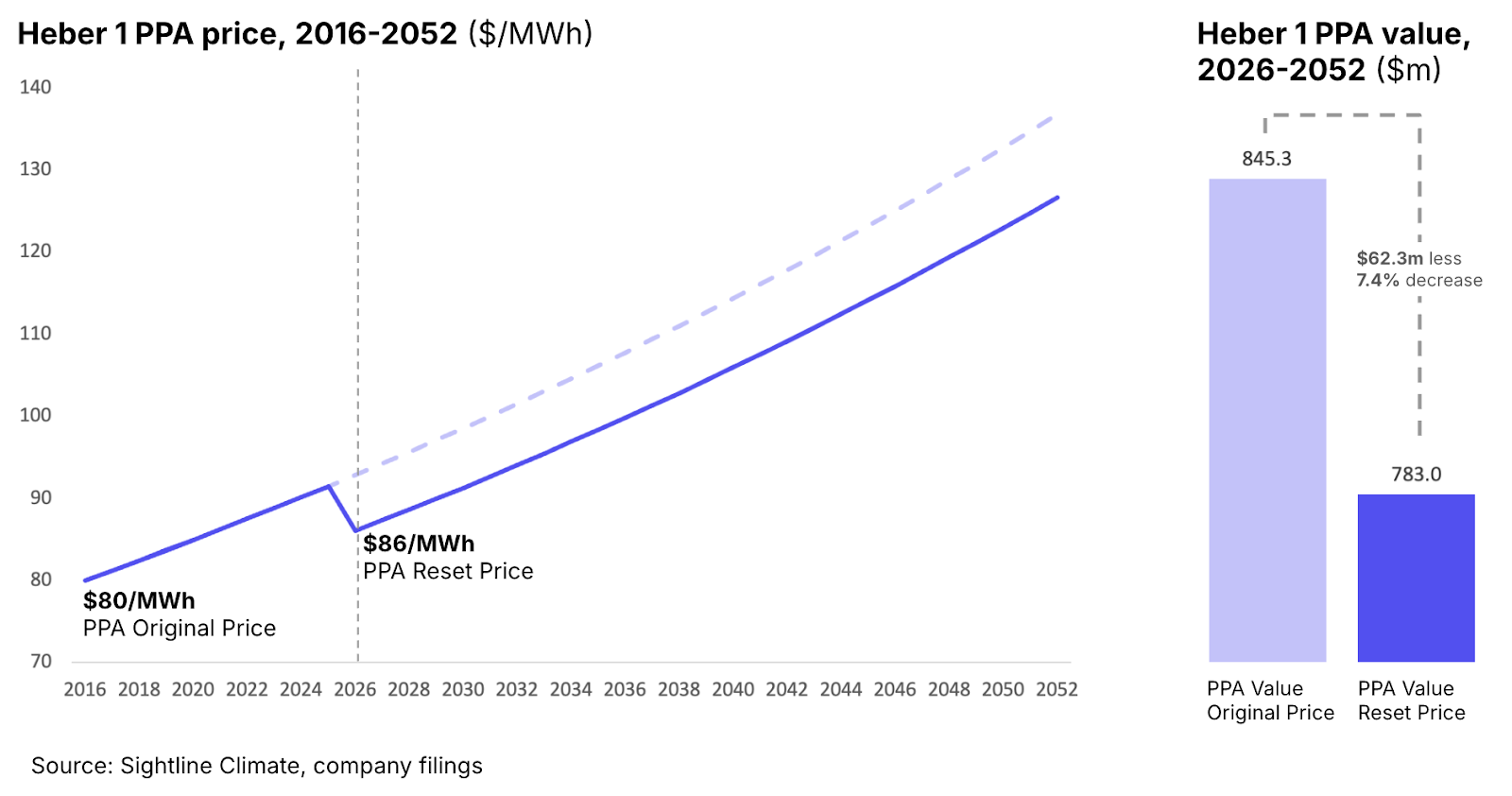
This is a win-win for both sides:
- LADWP and IID get access to clean energy target-compliant capacity in an environment where there is competition for every clean-firm MW — this competition, and the price for each marginal MW in the short term, is likely higher than what they just signed.
- Ormat gets a 25-year guaranteed return on an asset that has long since depreciated and, apart from the new cooling system, is almost totally opex — and is very likely to be well-below the $86/MWh they signed. We’ve seen other similar geothermal PPA renewals go for lower — e.g. $69/MWh for 20 years (2022-2041) for a PPA between Coso Geothermal and Southern California Public Power Authority — so it appears Ormat got a good deal.
In a power market rife with project development challenges and cancellations, a 25-year renewal of an existing asset is gold for both sides.
2. Uprating joins the party.
As Guy Cohen points out in a piece out today, geothermal’s fastest MW could come from uprating. Or, raising the capacity of existing plants by re-drilling, applying novel-EGS techniques, or even using AI to re-explore the site. We’ve seen this in action with Zanskar.
Last year Zanskar bought an underperforming site in New Mexico which was understood to be a very well-categorized geothermal resource. Applying their GeoCore AI model to it, the team found a higher permeability zone near the original wells. They re-drilled using latest technology, and bumped the Lightning Dock plant from about 4-7MW to 15MW.
Applying new tech at old sites seems to be a trend, with Greenfire Energy working with Calpine to increase output at The Geysers, and just yesterday Ormat announcing a partnership with Sage Geosystems to pilot its technology.
3. It’s all about the marginal clean firm megawatt.
If uprating takes off, it could become a real option for the utilities and hyperscalers looking for clean-firm power in the US. It represents a way to get to market faster, but also a way to spend less, given expansions will most often be cheaper. For example, Fervo’s PPA with NVEnergy for its upcoming Corsac Station project are listed at 155MW for 15 years at $107/MWh with no escalator. The Heber 1 PPA doesn’t hit that price until 2041.
There was a flurry of development in conventional geothermal across the western US in 2008-2012. Most of those facilities were on 15 to 20 year PPAs, and will be coming up to their expiration dates in the next few years — so if you’re on the hunt for MWs, maybe it’s time to make a few phone calls.